
Indie gaming continues to deliver a steady stream of small-scale experiments, quirky ideas, and nostalgic throwbacks – sometimes charming in their simplicity, other times frustrating in their lack of polish. This roundup highlights four recent PlayStation 5 releases that fit squarely into that space, each offering its own spin on familiar genres. From sewer-dwelling survival horror and minimalist puzzle hacking to candy-coated retro platforming and jet ski racing with the Smoots, these titles cover a wide spectrum of styles. The question, as always, is whether they manage to rise above their budget roots and leave a lasting impression.
Zooparasite review (PS5)
Mascot Bro Studio’s Zooparasite, published by Ratalaika, takes players deep into a network of grimy sewers where a chemical spill has twisted the local wildlife into grotesque mutants. The setup promises a mix of claustrophobic exploration and tense survival horror, and while there’s a certain charm in its B-movie premise, the execution is uneven. Armed with little more than a flashlight, a map, and the ability to hide in lockers, players are tasked with tracking down toxic containers and uncovering the truth behind the catastrophe. It’s a straightforward concept, but one that never fully capitalizes on its potential.
Gameplay unfolds like a stripped-down stealth horror experience, with roaches summoning larger bugs, giant spiders patrolling tunnels, and the occasional grotesque worm to evade. The mechanics are functional, if familiar: hiding in lockers, backtracking with the help of a map, and scrounging for first-aid kits. The problem is that the monsters rarely inspire real dread. They’re slow, predictable, and often too easy to outrun, which undercuts the intended sense of panic. On the other hand, achievement hunters may find some value here, as the game doles out trophies quickly and can be cleared in a single sitting.
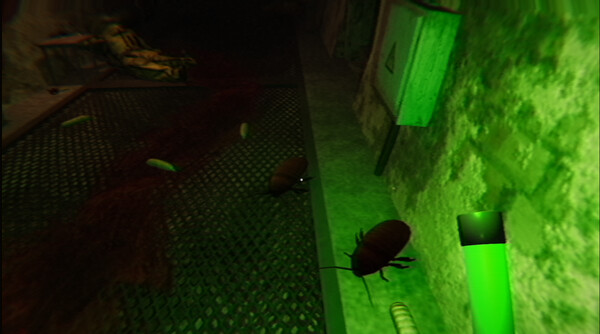
Controls are simple to the point of being stiff, and environmental clipping issues don’t do the game any favors. It’s not uncommon to walk through objects or see enemy limbs poke through hiding spots, small details that chip away at immersion. While the core structure works – find items, avoid threats, push deeper into the sewer – the lack of polish and originality makes it hard to stay engaged. The ending adds a little twist, but it’s unlikely to make most players want to revisit the experience.
What Zooparasite does get right is atmosphere. The dank, dimly lit environments and unsettling sound design do manage to conjure a sense of unease, even if the visuals themselves are muddy and repetitive. Creepy audio cues and the constant hum of the sewers lend the game a moodier edge than its mechanics deserve. Yet, despite these strengths, the whole package feels more like a fleeting experiment than a fully realized horror adventure. It’s an easy one-and-done, especially at its budget price point, but also one that’s quickly forgotten once the credits roll.
CORE.SYS review (PS5)
NipoBox and Eastasiasoft’s CORE.SYS is a minimalist puzzler dressed up as a retro hacking challenge, putting players in front of a 5×5 grid where the objective is to locate and input the correct code sequences. On paper, it’s a neat arcade-style concept, but in execution the game feels more like a stripped-back curiosity than a fully fleshed-out release. There’s no narrative setup to draw you in, and you’re thrown straight into the first puzzle with little context, which can make the experience feel impersonal.
Gameplay revolves around moving a cursor across panels, scanning for the correct sequence, and trying to complete each layer while avoiding digital “firewall” hazards. As the levels progress, new routines are introduced that shake things up, and the checkpoint system ensures that mistakes don’t wipe away too much progress. However, while the mechanics do grow in complexity, the moment-to-moment play rarely becomes truly engaging. It’s easy enough to adapt to each new wrinkle, and the lack of a deeper layer – whether that’s story, strategy, or intensity – means the repetition starts to settle in fairly quickly.

The presentation leans heavily on its retro aesthetic, which suits the hacking theme but doesn’t do much to elevate the gameplay. The visuals are busy with alphanumeric clutter but never especially stylish, and the audio is functional without leaving much of an impression. Controls, at least, are responsive and straightforward, though the overall simplicity makes the game feel closer to a mobile puzzle app than something designed to keep you hooked for long sessions.
As a budget title, CORE.SYS does succeed in offering a quick and accessible puzzle fix, especially for those looking to pad out their trophy list. But it’s also the kind of release that’s over almost as soon as it begins, with little reason to return once you’ve cleared its 60-odd levels. In a crowded puzzle space, it struggles to stand out, offering brief flashes of challenge without the lasting satisfaction that more inventive titles provide.
Candylands Journey review (PS5)
On the surface, Candylands Journey from Spell Pie and Sometimes You looks like a sweet slice of 2D retro platforming, complete with a young sorceress protagonist, bright pixel art, and a world map dotted with sugary lands. The premise is straightforward enough: recover a stolen crystal from pastry witches while navigating through 15 levels of enemies, traps, and puzzles. It’s clearly inspired by 90s platformers, but while it does a fair job at evoking nostalgia, the story is thin and never develops beyond its setup.
The platforming itself is solid, with smooth and responsive controls that make running and jumping feel natural. The sorceress begins with a simple bubble attack, but progression is tied to collecting gems that can be spent on new wands and hats, which alter abilities and add some variety. There’s a light puzzle element woven into exploration, with certain paths locked behind items that encourage replayability, though this also comes with some grind to afford upgrades. Unfortunately, the in-game shop doesn’t explain what items do, which feels like an oversight that undercuts experimentation.
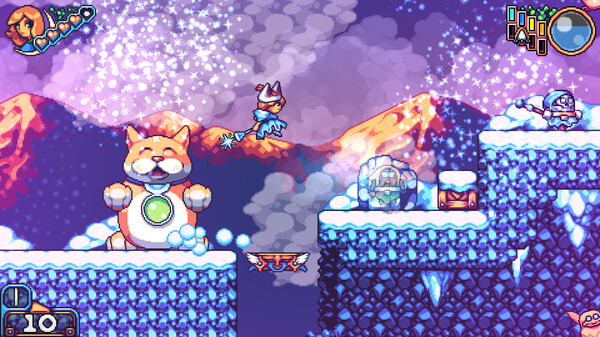
Visually, Candylands Journey is one of its stronger aspects. The levels are colorful and varied, from bright meadows to darker caves, all rendered in detailed pixel art. Character sprites look polished and the world map provides a clear sense of progression. The soundtrack matches the lighthearted tone, with upbeat tracks that shift into moodier beats in darker areas, while the sound effects – from enemy cries to magic attacks – fit the retro theme well. On PS5, everything runs smoothly, keeping the action fast and responsive.
As a throwback platformer, Candylands Journey hits the right nostalgic notes and offers a family-friendly experience that younger players may especially enjoy. But its lack of storytelling depth, occasional grind, and limited innovation mean it sits comfortably in the “decent but unremarkable” category. For genre fans hungry for another retro-styled adventure, it’s a pleasant diversion, though one unlikely to linger after the last cake tower is toppled.
Smoots Crazy Wave review (PS5)
With Smoots Crazy Wave, Jandusoft and Kaneda Games bring the familiar Smoots characters into a new arcade racing spin, swapping tennis courts and golf greens for jet skis and watery tracks. On paper, it’s a fun concept – especially with modes like Slalom, Battle Royale, and Championship – but in practice, the game struggles to capture the excitement of the genre it draws inspiration from. The premise taps into nostalgia for classics like Wave Race and Splashdown, yet it lacks the polish and immersion needed to live up to that comparison.
The gameplay offers variety across its modes, though most of them feel like minor tweaks rather than fully distinct experiences. Championship mode plays like a standard circuit, while Slalom introduces buoy weaving, and Battle Royale eliminates riders one by one. Power-ups are meant to add chaos but often end up poorly balanced, with some being weak and others overpowered to the point of breaking the flow. On the plus side, local multiplayer allows up to four players to race together, which can add a bit of party-style fun, even if the single-player content is too shallow to hold attention for long.
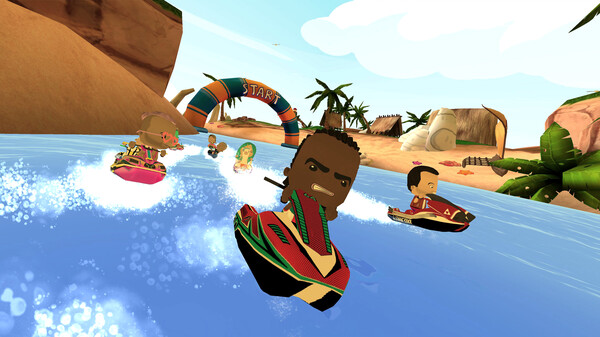
Where Smoots Crazy Wave stumbles most is in presentation and feel. While the tracks span tropical islands, icy landscapes, and mysterious ruins, the sense of water physics is surprisingly flat, often making races feel like they’re happening on painted blue roads instead of rolling waves). The visuals are serviceable but dated, with environments and character models that look closer to an early PS3 era release than a modern PS5 outing. Audio fares only slightly better, with upbeat but repetitive tracks that do little to lift the overall experience.
In the end, Smoots Crazy Wave is a lightweight racer that may work as a short distraction for families or groups of friends, thanks to its simple controls and budget price. But for players seeking a game that captures the thrill and challenge of water-based racing, it falls well short of expectations. The ambition is there, but the execution leaves the Smoots treading water rather than making waves.
 Press Play Media