
Ports often give overlooked indie gems a second life – and sometimes, a new audience discovers just how much they’ve been missing. Recent releases like LAPIN, Lorn’s Lure, Endoparasitic, and Super Mining Mechs all arrive on consoles after making their mark on PC, each bringing a distinct flavor of gameplay and atmosphere. From heartfelt 2D storytelling to punishing first-person climbs and claustrophobic horror, these ports show how diverse smaller-scale gaming can be when freed from platform constraints. Some thrive through refined controls or sharper presentation, others retain their scrappy indie charm – but all offer a glimpse into how far creative design can go when not weighed down by big-budget expectations.
LAPIN review (PS5)
LAPIN, developed by Studio Doodal and published by Alchemy Games, is a heartfelt 2D platformer that combines tight, precision-based gameplay with the warmth of a story about friendship, displacement, and hope. You play as Liebe, a white rabbit forced to leave her underground home after humans begin renovating the park above. Alongside her companions Captain, Bianca, José, and Montblanc, she embarks on a journey across treacherous landscapes and forgotten ruins. What begins as a simple quest for survival soon unfolds into a gentle reflection on change, community, and courage.
As a platformer, LAPIN shines brightest in motion. The controls are responsive, with a focus on momentum and timing rather than combat. Players must chain jumps, wall-climbs, and mid-air pivots to traverse intricately designed levels. The challenge escalates gradually, encouraging mastery without feeling unfair. While some sections demand high precision – especially in later stages – the consistent checkpoint system and forgiving respawn times keep frustration to a minimum. Beneath the cute visuals lies a surprisingly demanding platformer that rewards persistence and focus.

Outside of its platforming, LAPIN invests deeply in its cast of characters and atmosphere. Conversations with the other rabbits offer snippets of personality and emotion, adding a social dimension to the otherwise solitary gameplay loop. Liebe’s diary and collectible seeds give context to the world and its lore, fleshing out the rabbits’ history and the legacy of a legendary explorer named Jorge. These touches make exploration more meaningful, though some players might find the pacing uneven as narrative moments occasionally slow down the otherwise fast-paced flow.
Visually, LAPIN is simply charming. Its pastel backgrounds, hand-drawn animations, and soft lighting effects create a world that feels both soothing and alive. The gentle soundtrack complements this perfectly – light piano melodies and ambient tones follow you through each leap and fall. It’s a game that exudes warmth even when its difficulty spikes, though those seeking something more groundbreaking might find its formula too familiar. Still, between its emotional storytelling, tight platforming, and memorable presentation, LAPIN stands out as a lovingly crafted indie gem for players who enjoy their precision challenges served with a healthy dose of heart on the side.
Lorn’s Lure review (PS5)
Lorn’s Lure, developed by Rubeki Games and published by Feardemic, is a rare example of a platformer that manages to be both punishing and meditative. Set in a haunting, desolate megastructure, the game follows an android who abandons his colony to chase a mysterious glitch – an act that spirals into an obsessive descent through labyrinthine corridors and impossible architecture. The minimalist storytelling, told through fragmented text and environmental cues, leaves plenty of space for interpretation. It’s a world that feels alive despite its emptiness, and the absence of traditional NPCs or hand-holding only heightens the loneliness that defines the journey.
The core of Lorn’s Lure lies in its traversal, and it’s here that Rubeki’s design philosophy truly shines. Using twin climbing pickaxes, players can scale almost any surface, turning each wall into an opportunity and a threat. The sense of freedom is exhilarating, especially when combined with jumps, slides, and mid-air grabs that feel consistently responsive. That said, this freedom comes with a cost: the game is deliberately unforgiving. A mistimed leap or missed grip can mean plummeting several minutes’ progress, and while checkpoints are fair, they don’t soften the blow of repetition. Still, when you finally master a sequence after multiple failed attempts, it’s immensely satisfying – something only a handful of modern platformers manage to capture so well.

Visually, Lorn’s Lure evokes the eerie look of late-90s PC FPS games, with blocky environments rendered in muted tones that add to the oppressive atmosphere. The sparse use of color, minimal lighting, and deliberate sense of emptiness create an almost spiritual tension between beauty and decay. The sound design complements this perfectly: industrial hums, ambient echoes, and distant mechanical groans create a soundscape that’s as unsettling as it is immersive. It’s a world that feels ancient and forgotten, but still humming faintly with purpose.
As a whole, Lorn’s Lure won’t appeal to everyone – it demands patience, focus, and a tolerance for frustration – but for those who thrive on exploration and precision, it’s a uniquely rewarding experience. Its “climb-anything” design breaks the artificial constraints of most modern platformers, replacing convenience with consequence. The result is a game that feels refreshingly uncompromising: part mystery, part test of endurance, and wholly atmospheric. For players willing to lose themselves in its quiet intensity, Lorn’s Lure is one of the most memorable first-person adventures in recent years.
Endoparasitic review (Xbox)
Few horror games capture vulnerability quite like Endoparasitic does. Developed by Deep Root Interactive and published by Pineapple Works, this minimalist survival horror drops players into the role of a mutilated scientist crawling through the corridors of a doomed research facility, fighting both infection and monsters. On Xbox, the port retains the claustrophobic feel of the original PC version while offering tight gamepad support, translating its one-handed control concept surprisingly well to a console environment.
At its core, Endoparasitic thrives on mechanical tension. Every movement, reload, and vaccine injection is handled manually – a design choice that turns even basic actions into moments of stress. The feeling of dragging yourself along the floor while juggling limited ammo and a parasite timer creeping toward your brain keeps you on edge throughout. Combat is deliberate and demanding; one mistake or slow reaction can spell disaster. The need to load bullets one by one adds to the grim immersion, though it can also be more frustrating than thrilling, especially in later encounters where precision and speed become essential.

Visually, the game’s top-down pixel art is intentionally stark. The muted gray palette and smoke-filled corridors establish a grim, oppressive tone that perfectly complements its horror themes, though they can also make environments feel repetitive and navigation confusing. Sound design fares similarly – the ambient noise and distant creature growls heighten tension effectively, even if the soundtrack itself lacks variety. The limited number of enemy types and environments slightly dulls replayability, yet the game’s pacing and short runtime – roughly two hours for a first run – prevent it from overstaying its welcome.
Despite its rough edges, Endoparasitic stands out as one of the more inventive indie horror titles in recent years. Its raw, tactile gameplay turns limitation into design strength, and while the story doesn’t fully resolve its mysteries, the journey is compelling enough to recommend to fans of experimental survival horror. The Xbox version preserves the original’s intensity, making it a small but potent experience for players looking for a tense, skill-driven challenge rather than traditional scares.
Super Mining Mechs review (PS5)
In Super Mining Mechs, developer Delayed Victory and publisher Eastasiasoft revive the simple joy of digging for treasure with a clear nod to similar classics. The setup is straightforward: Earth’s resources are gone, and it’s up to you to mine a distant planet for precious materials. What unfolds is an addictive, grind-heavy loop of exploration, upgrading, and repetition – a design that’s as deliberate as it is nostalgic. It doesn’t try to disguise its simplicity, instead embracing it to create an experience that feels both accessible and quietly hypnotic.
The core gameplay centers around controlling your mech to dig deep into layers of soil and rock, collecting resources and ferrying them back to the surface to sell for upgrades. Every improvement – from stronger drills to larger storage tanks – adds another satisfying notch to the upgrade cycle. The deeper you go, the tougher the terrain becomes, and the lure of “just one more layer” keeps you coming back for quick sessions. Passive income systems, such as automated mining rigs, add a layer of idle-game convenience, though they also highlight how repetitive the process can become over longer playtimes.
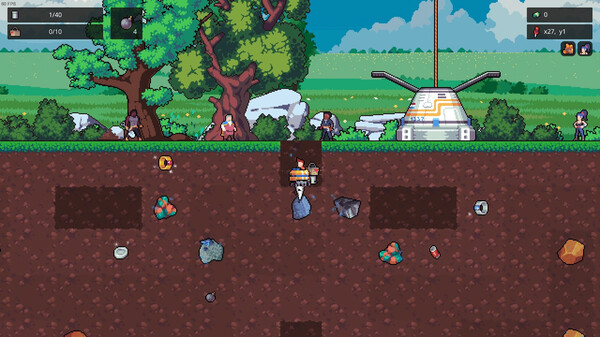
On PlayStation 5, performance is stable, and the simple visuals are clean and functional. There’s little visual variety between the game’s different worlds, but the colorful mineral textures and bright interface keep things readable and pleasant enough. The sound design is minimal, with gentle background tunes that fade into the experience rather than drive it – appropriate for a game often played in short, casual bursts. Co-op support for up to eight players adds a fun social twist, though it’s more a novelty than a necessity, given how little the core loop changes when others join.
As a whole, Super Mining Mechs delivers exactly what it promises: a compact, relaxing mining sim with plenty of grind and a rewarding upgrade loop. It’s best enjoyed in small doses, where its simple rhythm and progression systems can shine without overstaying their welcome. For players chasing deep storytelling or visual flair, this isn’t the place to look – but as a low-stakes, affordable indie experience that captures the spirit of old-school resource games, it hits its mark surprisingly well.
 Press Play Media