
The world of budget and indie releases is full of short, focused experiments – some succeed through clever mechanics, others through charm or nostalgia. This latest batch of PlayStation 5 titles covers that entire spectrum, from circuit-building puzzles and physics-driven chaos to retro platforming and a resurrected handheld classic. Electronics Puzzle Lab 2 revisits its logic-based roots with minimal evolution, while Piggly Pagly Boom brings an unexpected dose of lighthearted destruction to the mix. Kotenok offers a quick but uneven climb through pixel-art challenges, and Scurge: Hive revives a forgotten gem with its infection-fueled tension intact. None of these games are aiming for blockbuster depth – but together, they highlight the creative range and mixed fortunes of the indie scene’s smaller, faster, and sometimes stranger offerings.
Electronics Puzzle Lab 2 review (PS5)
Electronics Puzzle Lab 2, developed by Sagitta Studios and published by Eastasiasoft, picks up right where the first game left off – almost too literally. While it once again asks players to light up LED circuits using switches, capacitors, and logic gates, the déjà vu sets in early. Despite the inviting premise of solving circuit-based puzzles, the sequel offers little evolution from the original, reusing many of the same design ideas and even feeling like a copy-paste job in parts. It’s an semi-educational, logic-driven title that rewards patience and clear reasoning, but one that also risks losing players through sheer repetition.
The puzzles start simple enough – cutting wires, flipping switches, and ensuring blue LEDs stay off while red ones light up. The early learning curve is gentle, and the game does a good job explaining its core mechanics before layering in new twists, such as optional wires and opposing light goals. However, the excitement fades as you realize the deeper logic challenges are mostly variations of the same task. The game’s structure borrows from pipe puzzles more than authentic circuitry, and while that makes it approachable, it also limits its appeal for those expecting something more realistic or technical.

Mechanically, Electronics Puzzle Lab 2 works well enough – the flow of current is clearly visualized, making it easy to see how your choices affect the board. Unfortunately, that same visual clarity also strips away tension, since the puzzles rarely surprise you once the logic is visible. The controls are simple but lack precision when zooming in or panning around, which can frustrate when you’re trying to trace connections on complex boards. There’s also a noticeable lack of new content; the game introduces fewer components than its predecessor, even if capacitors appear earlier this time. The difficulty ramps up faster, yet the challenge never truly deepens, turning the experience into more of a steady routine than an engaging progression.
Visually, the game retains a clean, minimalistic look with nicely modeled workbench environments. These still look appealing, but there’s little incentive to stop and appreciate them since camera control is a bit clunky. Audio feedback is subtle and functional rather than immersive, matching the game’s utilitarian tone. What ultimately holds Electronics Puzzle Lab 2 back isn’t its technical execution but its lack of ambition – an opportunity missed to expand or innovate on a solid concept. For players who simply want an affordable, logic-based pastime or a quick trophy boost, it serves that purpose. For everyone else, this sequel’s recycled circuits might just short out your enthusiasm.
Piggly Pagly Boom review (PS5)
While Ratalaika Games has built a reputation for quick, affordable indie releases, Piggly Pagly Boom by developer 9Ratones might be one of the more charming examples of the bunch. This physics-based action puzzler puts you in the role of Morgan Pigman, a pig with a knack for explosions and chaos. What starts as a simple premise – clearing stages of rogue fireballs after a lab accident – quickly becomes an enjoyable mix of arcade precision and fun. The humor is as offbeat as the title suggests, and the game never takes itself too seriously.
At its core, Piggly Pagly Boom borrows from classics like Pang, challenging players to pop bouncing hazards with a hookshot rather than a traditional weapon. Each fireball you destroy splits into smaller ones until the screen is finally safe, and a ticking timer ensures there’s always some tension. Power-ups like shields, freezes, and faster ropes add strategic depth without complicating the flow too much. The inclusion of a jump mechanic also opens up mild platforming possibilities, letting you reposition quickly or grab time-extending pickups. The result is fast, clean, and surprisingly satisfying gameplay that hits the sweet spot between reflex and rhythm.
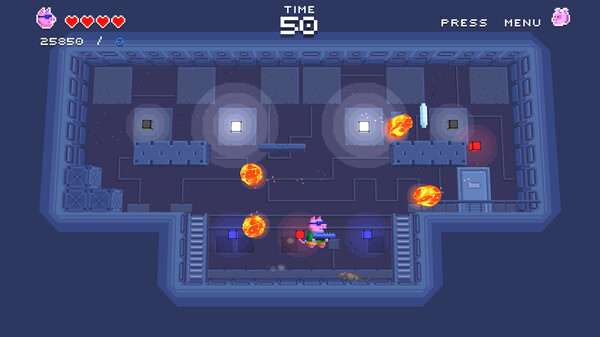
Still, the simplicity that makes it fun also keeps it light. Piggly Pagly Boom doesn’t pretend to be a deep or lengthy experience – most players will see the credits in under an hour, with achievements unlocking easily along the way. Some later levels can feel a bit repetitive, and a few power-ups lack clarity in how they work or when they’re most useful. The critters that occasionally block your shots are more irritating than inventive, especially when time is running out. Yet, despite these minor issues, the pacing is brisk enough to keep frustration low and satisfaction high.
Visually, the game is all cartoon color and cheerful energy – explosions pop, characters bounce, and the playful tone is reinforced by upbeat tracks that fit the chaotic mood. It’s a modest production, clearly built for short bursts of play rather than long sessions, but it succeeds at exactly what it aims to do: deliver a bite-sized blast of retro-inspired fun. Whether you’re chasing a few easy trophies or just want to unwind after work, Piggly Pagly Boom offers a good-natured dose of pig-powered destruction that’s worth its low asking price.
Kotenok review (PS5)
For every retro-inspired platformer that manages to balance nostalgia with tight design, there’s one that feels content to simply exist – Kotenok unfortunately falls into the latter category. Developed by NipoBox and published by Eastasiasoft, this budget title stars a small cat leaping through fifty short levels of spikes, enemies, and forest scenery. On paper, it’s a charming concept, but the experience never really claws its way above average execution.
The core gameplay loop is simple: reach the flag at the end of each stage, using jumps and double jumps to dodge hazards and bop enemies. While the double jump adds a bit of rhythm to movement, the imprecise controls and inconsistent hit detection often undermine that sense of flow. It’s not uncommon to misjudge a landing or die even when seemingly clear of danger, which are issues that cheapen what should be a straightforward but fair challenge. The game’s short runtime of roughly an hour ensures the frustration doesn’t linger too long, but it also highlights how shallow the design is, with no real evolution or surprises along the way.
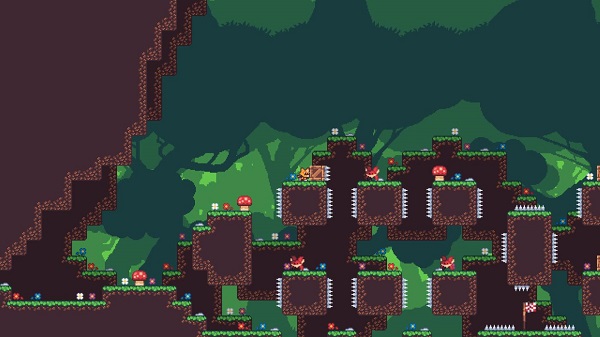
Visually, Kotenok embraces colorful pixel art, but it’s far from distinctive. The layered backgrounds, while initially appealing, sometimes blur the line between playable terrain and decoration, leading to confusion and needless mistakes. It’s easy to mistake a background ledge for a solid platform, and the repetition of the forest theme across all stages doesn’t help with variety. The result is an aesthetic that’s serviceable but inconsistent, doing little to make the adventure feel memorable or inviting.
Once you’ve cleared all fifty levels, there’s little reason to return. The optional collectibles don’t unlock anything, there are no leaderboards or hidden stages, and the absence of any boss battles or score system leaves the experience feeling like a one time affair. For trophy hunters or those seeking a quick dose of pixel nostalgia, Kotenok might be a tolerable way to fill an hour. But for anyone looking for precision, personality, or lasting appeal, this kitten’s adventure lands squarely on its feet – and goes nowhere from there.
Scurge: Hive review (PS5)
Scurge: Hive casts you as bounty hunter Jenosa Armaon on a race to contain a parasitic virus, and that compact premise is the game’s strongest virtue: it keeps goals clear and stakes immediate, which suits the game’s arcade-minded design and short, punchy levels. The story never becomes more than functional sci‑fi scaffolding, but it supplies enough urgency to justify the infection meter and its constant pressure, making each mission feel like a small, self-contained sprint rather than an open-ended exploration. Originally a DS title, it’s now out on all consoles.
Combat and platforming form the core loop, and the game does a lot with limited tools: weapon variety and a modest upgrade system encourage tactical swapping, while the infection mechanic forces quick judgment calls about when to press forward and when to retreat to safety. That loop is satisfying in bursts – tight firefights and puzzle-adjacent obstacles create memorable moments – but difficulty spikes and occasional enemy placements can feel punitive, turning a tense encounter into a tedious retry session when combined with stingy checkpointing. The included features like rewind, save states, and cheats on modern releases soften that edge, but they also highlight how the original handheld pacing sometimes clashes with longer play sessions on consoles.

Controls on PS5 are generally serviceable, translating the handheld-era responsiveness into a console context without major problems, though a few maneuvers still feel like they were built around a DS-style precision rather than an analog stick. Level design favors tight arenas and verticality, which rewards good aim and spatial awareness but occasionally punishes sloppy camera angles and cramped sightlines. The infection meter adds a clever resource layer that elevates otherwise routine platforming into tense risk-management, but it can also limit the freedom to explore and experiment in later stages when margin for error narrows.
Presentation wears its age with a fond, slightly faded charm: sprite work and effects retain character but look rougher at higher resolutions and large screens, while background detail is often functional rather than richly realized. Audio does a lot of heavy lifting, with tense, atmospheric music and sharp sound cues that sell combat intensity and help cover for visual limitations. If you want a concise, old-school action experience with a clever mechanical twist, Scurge: Hive on PS5 delivers a compact thrill that’s easy to recommend for short sessions; though if you expect modern technical sheen or a leisurely, story-rich adventure, this port exposes the edges of the original design.
 Press Play Media