
Ports can be a mixed bag – sometimes they breathe new life into overlooked gems, other times they expose the seams of games that weren’t built to last. This latest wave of PS5 arrivals shows both sides of that coin. From the bullet-absorbing chaos of Schildmaid MX, to the stripped-down arcade loops of StarLightRiders: HyperJump, and the VHS-drenched dread of Christmas Mutilator, each title brings its own flavor of retro-inspired intensity. Together, they highlight how developers are reimagining old-school design for modern hardware: sometimes inventive, sometimes rough around the edges, but always fascinating to pick apart.
Schildmaid MX review (PS5)
Schildmaid MX’s leap to PS5 brings a shooter that’s equal parts nostalgia and weird invention – and that’s exactly where it works best. At first glance, it’s a familiar space-shmup: pick one of three ships, gun down waves of invaders, battle bosses, and try to climb the leaderboards. But what sets Schildmaid MX apart – and what remains intact and effective in this PS5 version – is its oddball “absorb the bullets to get stronger” mechanic. Getting hit isn’t always a death sentence: it charges your shield, builds your firepower, and forces a delicate dance of timing and risk. When you push absorption too far and see the “danger” cues, things get tense quickly. The satisfaction when you survive a hailstorm of bullets and emerge obliterating enemy waves is oddly cathartic – a rare, risky payoff in a genre often driven purely by avoidance and memorization.
That design makes the gameplay feel fresh and dynamic even for genre veterans. For newcomers, there’s a gentler entry: the easier mode lets you get accustomed to controls and core mechanics without overwhelming you, before the harder Krieger, Chimera, or Sieger modes drop you into full bullet-hell chaos. The three ships offer just enough variation in weapons and handling to encourage experimentation, even if the shield behavior remains constant. Still, once you hit the advanced modes, the game can get brutal – and not always because the design is unfair, but because the sheer volume of projectiles demands razor-sharp reactions.

Visually and aurally, Schildmaid MX on PS5 leans heavily into retro charm while keeping things sharp and readable. The pixel-art style, smooth frame-rate, optional CRT emulation and vibrant explosions evoke the golden age of shmups without making the action murky or confusing. The soundtrack is punchy, and the “boom and fire” of sound effects – including those crucial “danger” warnings – does a fine job of ratcheting up tension when the bullets start flying. On the downside, the music can feel at odds with the visual intensity, and the level design occasionally loops familiar patterns rather than pushing through to something more inspired.
Narratively, don’t expect much – Schildmaid MX never pretends to be a stellar sci-fi epic. The premise is serviceable at best, and the “space Valkyrie against the invasion fleet” framing mostly serves as context for the action rather than any deep story. But that’s fine, because this is not a narrative-driven shooter: it’s about rhythm, timing, and chaos. In that regard it succeeds – it doesn’t waste time on plot, but delivers consistently satisfying shootouts that reward aggression, risk-taking, and adaptation. It may lack narrative ambition or lavish level variety, yet when it works – and most of the time it does – it feels like bullet-hell alchemy.
StarLightRiders: HyperJump review (PS5)
StarLightRiders: HyperJump on PS5 delivers a fast and frantic arcade-style shoot-’em-up that wears its retro inspirations proudly. From the moment you grab control of a HyperJump ship, the gameplay centres on frantic dodging, weapon-switching between spread-shot and concentrated beam, and scrambling for reactor pickups to charge your warp engine – all under constant threat from alien swarms. The controls remain tight and responsive even when the screen is full of bullets, which is crucial given how quickly intensity ramps up.
When you find the groove – weaving between projectiles, unleashing bombs at the right moment and switching between shot types depending on the threat – the game offers a visceral burst of old-school arcade satisfaction. The pixel-art visuals and chiptune-leaning soundtrack lean into nostalgia, and for what the game is, they succeed: enemies shimmer and explode, backgrounds scroll, and bosses loom large in that stylized, sprite-driven way that recalls dedicated shoot-’em-ups of decades past.

However, that simplicity is also the game’s greatest weakness. There is virtually no narrative beyond barebones transmissions, no meaningful progression or unlocks, and little variation across the five stages – you’re essentially doing the same loop: waves of enemies, boss, repeat. Once familiarity sets in, the challenge begins to feel repetitive, and with only five levels and no meta-game or unlockable content, replay value drops off fast.
More frustratingly, the challenge sometimes feels less like rewarding difficulty and more like rough edges: hit-detection can be inconsistent, and there are moments when bullets seem to clip you unfairly – the margin for error is slim, and what should be about precise dodging occasionally feels cheap. That, combined with its minimal ambitions, makes StarLightRiders feel at times like a prototype rather than a fully fleshed-out modern release.
Christmas Mutilator review (PS5)
Playing the PS5 version of Christmas Mutilator feels like stepping into an old VHS-era slasher flick transplanted into interactive form – and for a good stretch, it works. The retro PSX/VHS-style visuals combined with the snow-bound cabin setting immediately evoke a cold, claustrophobic dread. The sense of isolation, enhanced by the howling winter storm outside and the dim, flickering interiors, does a lot of the heavy lifting: every shadow, every creaking floorboard feels loaded, and that tension is the kind of dread you’ve got to earn – and the game earns it.
The stealth-driven design and the reactive killer AI add real unpredictability to the proceedings, which keeps the stakes high. It rarely feels like a scripted jump-scare; instead, every moment demands careful thought, silence, and restraint. You’re not just hiding, you’re constantly assessing – will that noise give you away, is that shadow just a corner, or something more sinister? That gradual build-up and uncertain pacing give the horror a visceral weight. The phone-mechanic and subtle hints of family drama – especially the cracks forming in the relationship between protagonist Amelia and her husband – add psychological texture beyond mere survival. The horror isn’t just physical: there’s an emotional, uncanny undercurrent to what you’re experiencing.
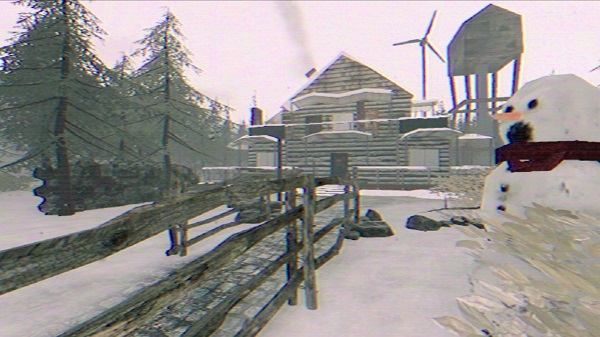
But the game isn’t without its flaws – and those flaws might limit who will enjoy it. The stealth mechanics, while tense, can feel unforgiving. One misstep often means instant death, and the dynamic AI, for all its power, can sometimes feel overwhelming – making stealth less a tense dance and more a high-stress trial. For some, that’s part of the appeal – but for others, it crosses into frustration. We also saw occasional small bugs, which can undercut immersion at inopportune moments. Also, the retro graphics, which for many are a key part of the vibe, risk feeling dated or too stylized for others – the aesthetic is a matter of taste.
Ultimately, Christmas Mutilator won’t be for everyone – but as a piece of indie horror built around dread, atmosphere, and old-school slasher sensibilities, it delivers a chilly, uncompromising ride. If you go in expecting a polished AAA production, you’ll probably be disappointed. But if you embrace the rough edges and allow the tension and dread to slowly creep in, you’ll find a game that wears its 80s horror inspirations on its sleeve – and leans into them with brutal elegance.
 Press Play Media