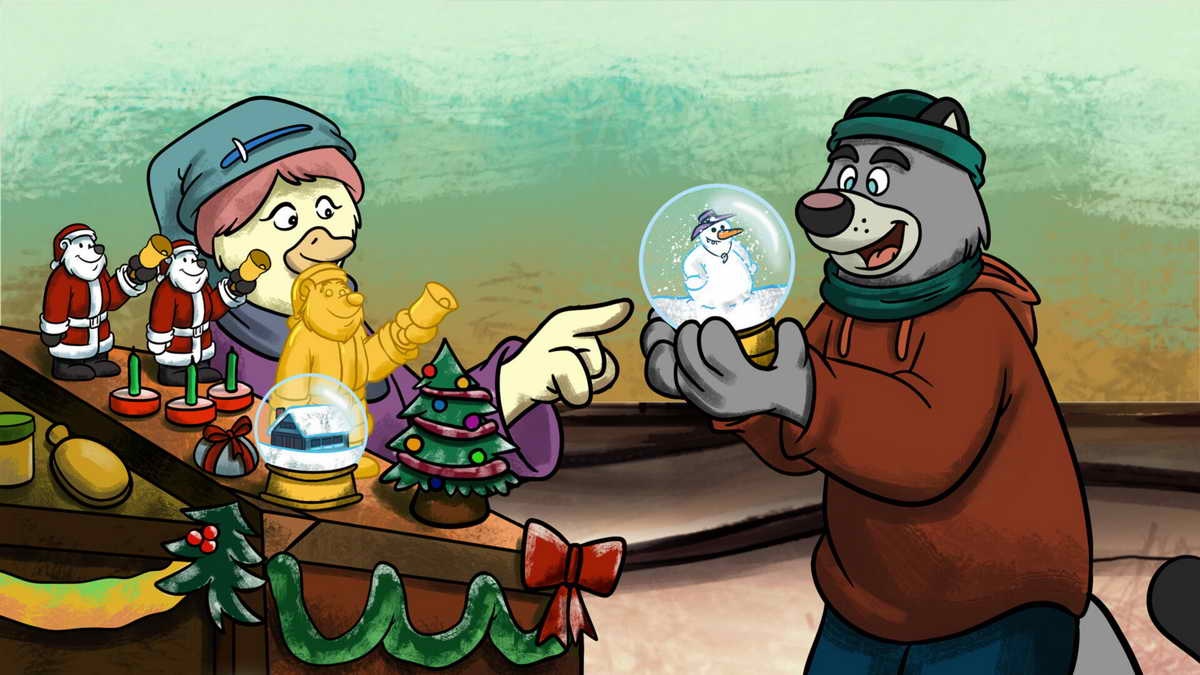
As the end of the year approaches, seasonal releases once again attempt to thread the needle between festive novelty and meaningful play, wrapping familiar genres in tinsel while testing whether Christmas theming can offer more than a fleeting smile. This small roundup brings together three very different interpretations of holiday gaming, each approaching the season from a distinct angle: a reflective narrative vignette rooted in an established universe, a party-focused VR diversion built on spectacle and silliness, and a compact arcade shooter that treats Christmas as a high-score battleground. Taken together, they offer a snapshot of how seasonal releases can range from thoughtful extensions of broader worlds to unabashedly disposable fun, inviting players to decide whether they are looking for introspection, laughter, or short-burst chaos during the festive break.
BROK: Natal Tail review (PS5)
BROK: Natal Tail, A New Christmas Special reframes the bleak dystopia of Atlasia through a deceptively simple visual-novel lens, inviting players into a narrative that blends earnest character work with somber worldbuilding. The expanded PS5 Special Edition enhances the console experience with choice-driven branches and unlockable achievements, grounding the story of Graff and Ott’s attempt to earn status through the corrupted “Natal Untail” ritual in a way that feels both intimate and weighty. While the premise evokes holiday themes, the narrative consistently subverts expectations with a focus on sacrifice, camaraderie, and the subtle tensions of friendship rather than overt festive cheer.
Mechanically, the game adheres firmly to the conventions of its genre, offering minimal interactivity outside of sporadic decisions that meaningfully affect narrative beats. For players who enjoy visual novels, this approach feels purposeful – the text is briskly paced, and chapters are structured to be absorbed in concise sittings, while an auto-mode respects readers’ preferences for a more passive experience. That said, the limited agency and lack of replay incentives temper the appeal once the core narrative arc has been exhausted; choices do extend playtime modestly, but the absence of deeper branching or mechanical variety ultimately constrains longevity.
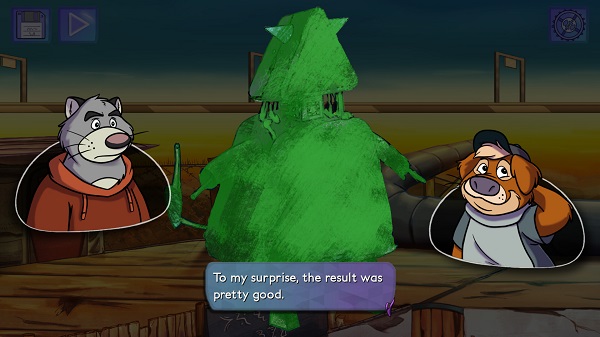
Visually and aurally, the Special Edition holds up well for its scope. Clean character models and varied backgrounds establish a distinct atmosphere, and the audio – both the understated musical cues and environmental effects – complements the narrative’s tonal shifts from bleak to tender without overpowering them. Controls are serviceable and intuitive, with accessibility options that support a wide audience, though the reuse of assets from the main BROK title and the absence of voice acting will be felt by those expecting a more dynamic presentation. These choices reflect a clear prioritization of storytelling over spectacle, which will resonate more strongly with some players than others.
Ultimately, BROK: Natal Tail, A New Christmas Special stands as a poignant supplement to its parent universe, one that will particularly reward existing fans and readers drawn to character-centric tales. Its narrative ambition and emotional sincerity outweigh its structural limitations, giving players a reflective holiday tale that is touching without feeling saccharine. While its brevity and constrained interactivity may leave some craving more, the experience offered here is a thoughtfully crafted vignette that expands upon the broader BROK mythos in meaningful ways.
Jingle Strike VR Bowling review (Quest)
Jingle Strike VR Bowling leans heavily into its holiday gimmick, casting players as Santa hurling bowling balls down festively dressed lanes while a crowd of animated elves heckles every success and failure. On paper, the setup promises lighthearted party chaos, and the presentation does deliver a recognisably Christmassy atmosphere, complete with jingling music, snow-dusted environments, and constant background chatter. The problem is that once the novelty of being verbally needled by farting, dancing elves wears thin, the game struggles to provide much beyond its surface-level joke.
At its core, the bowling itself never quite feels right compared to other VR bowling games. The ball lacks convincing weight, with throws often floating unnaturally and behaving inconsistently, which undermines any claim to realism. Hand positioning exacerbates this, forcing players to adopt awkward, counterintuitive throwing motions to keep the ball on the lane. Spin and hook are either extremely limited or functionally absent, flattening the skill curve and making traditional bowling techniques ineffective. While it is possible to adjust and score the occasional strike, it feels more like working around the system than mastering it.
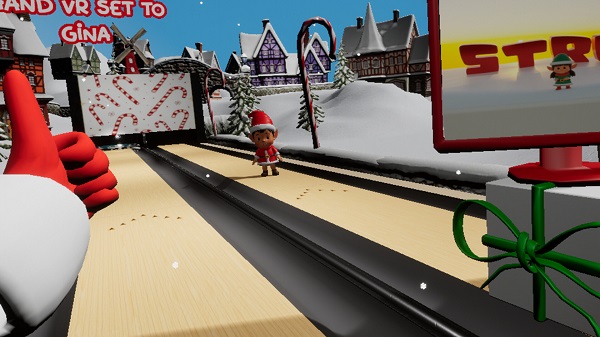
There are a handful of modes and locations, including the faster-paced 85 Second Slam-Down, which strips away the festive trappings in favour of neon visuals and rapid-fire pin resets. This mode briefly injects some energy, but technical issues repeatedly interrupt the flow, with pins failing to respawn correctly and scoring behaving unpredictably. Elsewhere, the standard lanes differ more in decoration than substance, and visual fidelity remains basic throughout, with sparse environments and animations doing most of the heavy lifting. Audio is similarly uneven: the music is serviceable seasonal filler, while the elves’ voice lines quickly become repetitive and more grating than humorous.
Where Jingle Strike VR Bowling does find a small foothold is as a local, pass-the-headset party distraction. The couch-based multiplayer setup makes it accessible for families or newcomers to VR, and there is some fleeting amusement in watching others wrestle with the controls while the elves pile on the sarcasm. Still, persistent glitches, shallow mechanics, and unconvincing physics make it difficult to recommend beyond a very narrow festive window. As a novelty, it raises a smile; as a bowling game, it leaves far too many pins standing.
Big Trouble in Little Chimney review (Xbox)
From its opening salvo of enemies pouring from the eponymous chimney to its frantic ten-minute runs, Big Trouble in Little Chimney delivers a compact arcade shooter experience where relentless bullet-hell action, seasonal aesthetics, and score-chasing design converge into a budget-friendly package. At its core, the game asks players to embody a heavily armed Santa figure battling a gauntlet of holiday-themed foes in an effort to “save Christmas,” a premise that sets the tone for both its charm and its limitations. The premise is light on narrative depth, functioning more as a framing device for wave-based combat than as a story with emotional stakes, but it does establish a clear, festive context for the gameplay loop that follows.
Mechanically, the Xbox build translates the twin-stick shooter fundamentals into a tight, responsive control scheme that feels intuitive from the outset, though nuances such as optional aim assists underscore both its accessibility and its rough edges. Movement and firing are straightforward, which suits the short burst nature of the runs, but some control choices – like the lack of an auto-shoot option – surface as friction points in longer, more intense stretches. The inclusion of a secondary mode adds conceptual variety, though its depth falls short of the main mode’s satisfying intensity. Permanent upgrades and unlockable weapons add layers of progression that reward repeated attempts, yet once the core systems are understood and most gear is acquired, the incentive to keep pushing beyond personal bests diminishes somewhat.
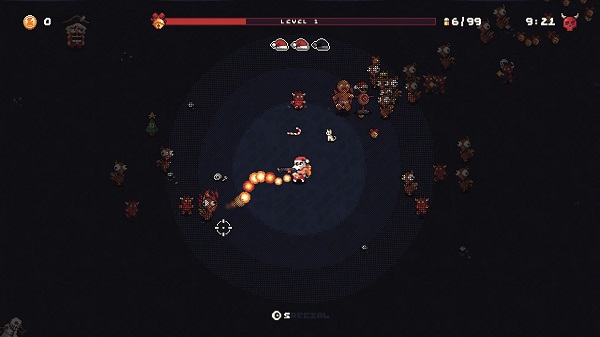
Visually and sonically, the game leans into handcrafted pixel art and jaunty compositions that imbue each run with a playful, seasonal energy. The graphical style is unabashedly throwback, and while it does not aim for visual sophistication, it succeeds in creating character and approachable readability even amidst on-screen chaos. Music and sound design complement this aesthetic, reinforcing the arcade vibe and keeping the atmosphere buoyant during both the main survival runs and the alternate mode.
Where Big Trouble in Little Chimney excels is in its addictive, pick-up-and-play nature – runs are short, challenges are immediate, and progression systems provide just enough reward to entice another go. However, this design also highlights its chief limitations: once upgrades are unlocked and patterns are learned, the novelty can taper quicker than some players might hope, particularly in modes that lack the balance refinement of the primary loop. Nonetheless, for its modest price point and the polished simplicity of its execution, this Xbox version stands as a fun, festive bullet-hell romp – best appreciated in small doses but worthy of attention from fans of arcade-style shooters and holiday-themed chaos alike.
 Press Play Media