Indie games continue to thrive in the spaces between and within genres, blending familiar mechanics with fresh twists and modest ambitions that often prioritise clever design over spectacle. This latest roundup spans everything from hands-off brick-breaking reimagined as a roguelite optimisation loop, to stripped-back logic puzzles wrapped in post-apocalyptic dressing, and a more expansive tile-rotation journey across elemental biomes. While each of these PS5 titles approaches progression, challenge, and presentation in very different ways, they share a common focus on distilled gameplay ideas and accessible experiences.
Hextreme Void review (PS5)
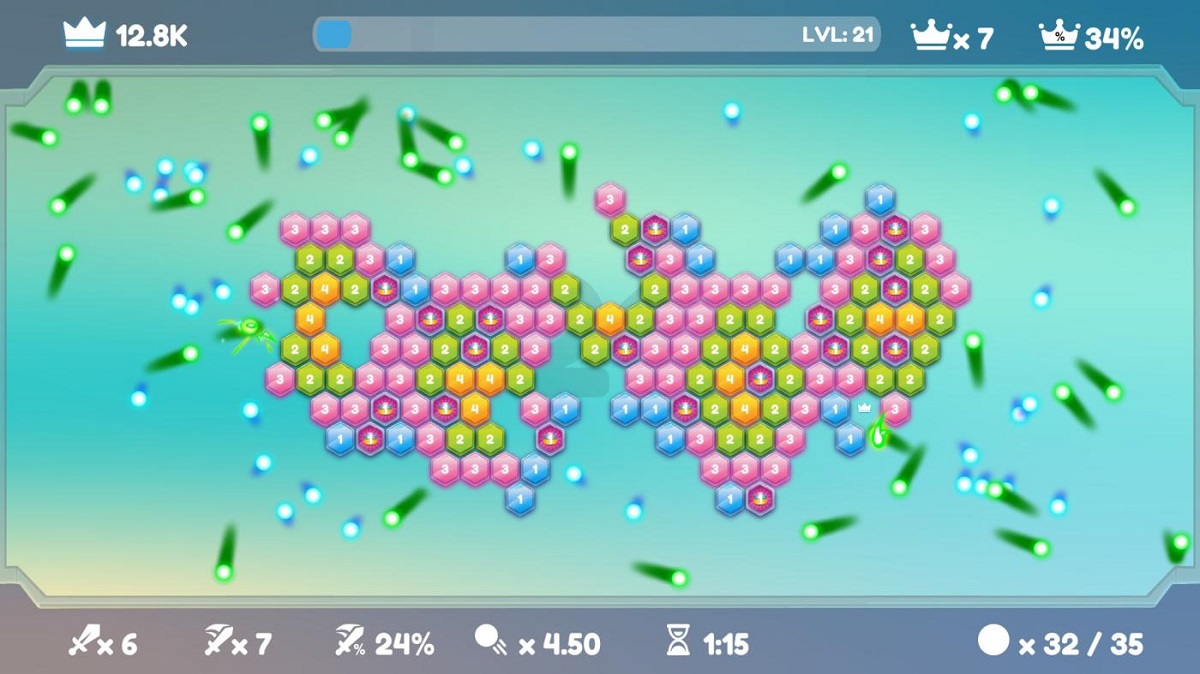
Hextreme Void on PS5 takes a simple, classic premise – brick-breaking – and reframes it around optimisation and progression rather than reflexes. Instead of paddles or direct control, balls bounce autonomously across neatly rendered hexagonal grids, and your only real input is choosing when and how to deploy the power-ups and perks that appear. This loop of clearing tiles, levelling up mid-run, and then spending coins on permanent upgrades feels initially rewarding, with each decision nudging you just a bit deeper into the next Void and encouraging experimentation with different builds. The result is a brick breaker that feels more like a laid-back strategy game than an arcade challenge, and at first this emphasis on planning over twitch inputs creates a distinctive rhythm that can be oddly compelling.
Where this core idea begins to show its limits is in how quickly the systems settle into a comfortable groove. After only a handful of hours you’ll likely have unlocked most of the key upgrades that matter – extra balls, increased damage, expanded timers – and runs start feeling almost automatic. In those later stages, the sense of discovery fades, and there’s little to disrupt the pattern or introduce fresh challenges. The lack of meaningful variety in level layouts or hazards across the five Voids only amplifies that sameness, leaving the experience feeling repetitive over time despite its clever framework. Visually, the PS5 version stays true to the clean, high-contrast presentation seen elsewhere: clear colours and intuitive boards make it easy to track progress, but animation and level variety are minimal, and the audio – while pleasant – isn’t memorable enough to elevate the subdued pace.
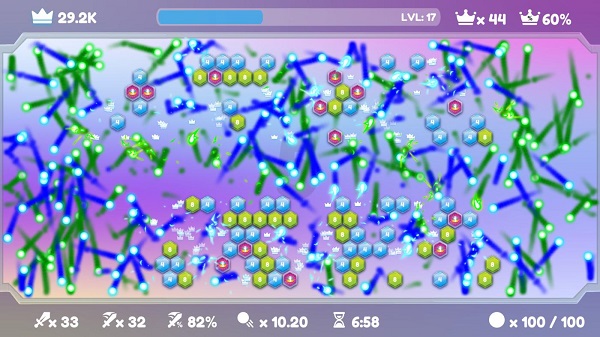
Controls are almost nonexistent by design, and while that’s part of the twist, it also means the feedback loop rests entirely on upgrade choices rather than gameplay mastery. For players who enjoy thoughtful optimisation and watching numbers tick upward, this can be satisfying; for those hoping for deeper interaction or a tougher learning curve, it can feel like the game plays at you more than with you. Some runs can drag a bit early on, and the reliance on random perk selections occasionally leads to runs that feel more luck-dependent than skillful, highlighting the balance issues in its roguelite approach.
Ultimately, Hextreme Void on PS5 is a competent, well-polished indie title with a refreshing spin on an old formula, and it’s easy to recommend for short bursts of play or for players who like optimisation and incremental progression. That said, once the core loop is mastered and key upgrades acquired, there’s little to keep you coming back in the long term: the lack of post-game goals, leaderboard features, or significant level variation means the experience peaks early and plateaus quickly. For its modest price and pick-up-and-play nature, it’s a fun diversion, but it doesn’t quite stretch far enough to be a standout in its genre.
Gridz Keeper review (PS5)
Gridz Keeper’s premise plants you in a post-apocalyptic world where fractured power grids are the last bulwark against humanity’s collapse, tasking you with toggling generators back online across 50 puzzle stages. The narrative framing gives the game a thematic hook, but beyond the setup there’s little in the way of storytelling or emotional payoff, leaving the zombie apocalypse mostly cosmetic rather than impactful in play. That thematic underuse can make the opening promise feel like a missed opportunity; a touch more context or character investment would have helped sell the stakes as you move between grids.
Mechanically, Gridz Keeper is faithful to the classic “Lights Out” puzzle template: toggling a generator changes its state and affects adjacent ones, and success demands seeing several moves ahead rather than reflexive action. The simplicity of this core idea is both its strength and weakness – it makes for instantly graspable logic puzzles and short bursts of satisfaction when patterns click together, but it also means the challenge rarely evolves beyond its base concept. More seasoned puzzle fans will likely find the difficulty plateau predictable, while newcomers or younger players may appreciate the gentle learning curve.
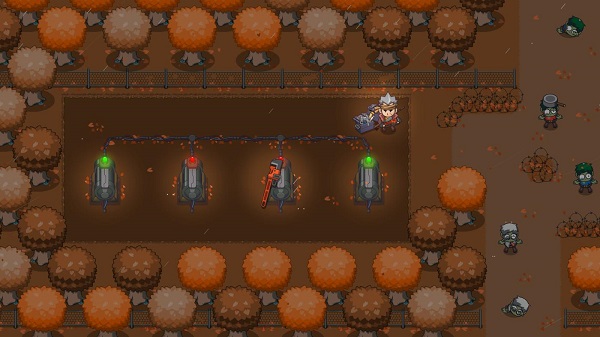
On PS5, controls are straightforward and responsive, letting you focus entirely on the logic rather than on input quirks, and the “wrench cursor” scheme feels crisp and deliberate. Visually the game opts for clean, bright grids and easily readable generator icons, which serve clarity well but contribute to a somewhat bland overall presentation. Backgrounds and environments remain static across stages, and the zombie motif barely registers beyond occasional static sprites that neither threaten nor interact, undercutting the post-apocalyptic tension the premise suggests.
Audio design mirrors the visuals: functional and unobtrusive but not particularly memorable. While the game’s brief runtime – often completed in around thirty minutes – might appeal to achievement hunters or those after a quick logic fix, it leaves little to digest once the credits roll. Gridz Keeper’s distilled focus on a singular puzzle mechanic offers occasional satisfaction, but without additional modes, deeper systems, or a more engaging use of its setting, it feels slight and repetitive rather than a compelling puzzle journey.
Tiny Biomes review (PS5)
Double Mizzlee’s Tiny Biomes greets the player with a deceptively simple premise – restore vitality to fractured landscapes by directing elemental flows through a series of interconnected tiles. The narrative itself is minimal, serving mostly as a thematic tag for the clever puzzles ahead rather than a rich story thread, but there’s enough contextual charm in moving between biomes like forest, volcanic, and winter regions to sustain interest beyond the mechanics. The progression through these distinct zones gives a satisfying sense of traversal and escalation, even if the stakes never feel particularly high; it’s a puzzle game more concerned with patterns and logic than with dramatic narrative twists.
Gameplay hinges on rotating tiles to create a continuous path for water, lava, or snow to reach target destinations, and this framework rarely strays from its core design across the 150+ levels. Early puzzles introduce concepts at a measured pace, but as complexity ramps up with branching routes, new tile types, and tighter move counts, a pleasing tension emerges between relaxation and challenge. The three-star performance metric based on move efficiency incentivizes replay and efficiency, though its presence sometimes transforms what could be leisurely thought experiments into exercises in trial-and-error frustration, particularly on later stages where optimal solutions feel opaque. Despite these hurdles, few mechanics feel superfluous; the demands of each biome’s unique elements keep the formula engaging even if the loop eventually feels familiar.
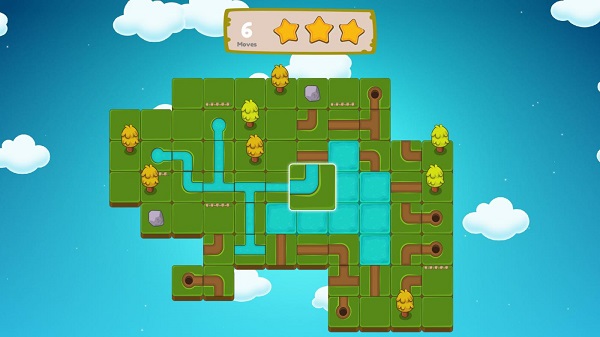
Controls on the PS5 are precise and responsive, with tile rotation feeling intuitive whether navigating with a controller or toggling between paths. The absence of optional hints or adaptive difficulty also means that players without a tolerance for repetition and deduction may find their momentum checked at certain junctures, underscoring how Tiny Biomes caters more to methodical thinkers than to casual puzzle dabblers.
Visually, the game presents its worlds in a clean, appealing top-down aesthetic with enough variation between biomes to keep environments distinctive without overwhelming the senses. The audio follows suit with a gentle soundscape that complements the contemplative pace rather than demanding attention. While neither the visuals nor the sound design break new ground, they provide a harmonious backdrop that aligns with the game’s meditative rhythm. Ultimately, Tiny Biomes delivers a thoughtful, expertly constructed puzzle experience that’s easy to admire, hard to master, and modest in its ambitions – a fitting offering for players who relish incremental logic challenges even if they prefer a more robust narrative or mechanical evolution.
 Press Play Media