Indie games often find their strength not in scale, but in conviction – in taking a singular idea and committing to it without compromise. In this trio of recent releases, that philosophy is on full display. From the paddle-powered masochism of Salmon Man on Quest, to the quietly unnerving anomaly hunting of The Stairwell on PS5, and the offbeat feline cruise adventure of Ship’s Cat on PS5, each title carves out its own tightly focused identity. They may differ wildly in tone and mechanics, but all three demonstrate how smaller teams can leverage precision, atmosphere, and sharply defined loops to create experiences that linger.
Salmon Man review (Quest)
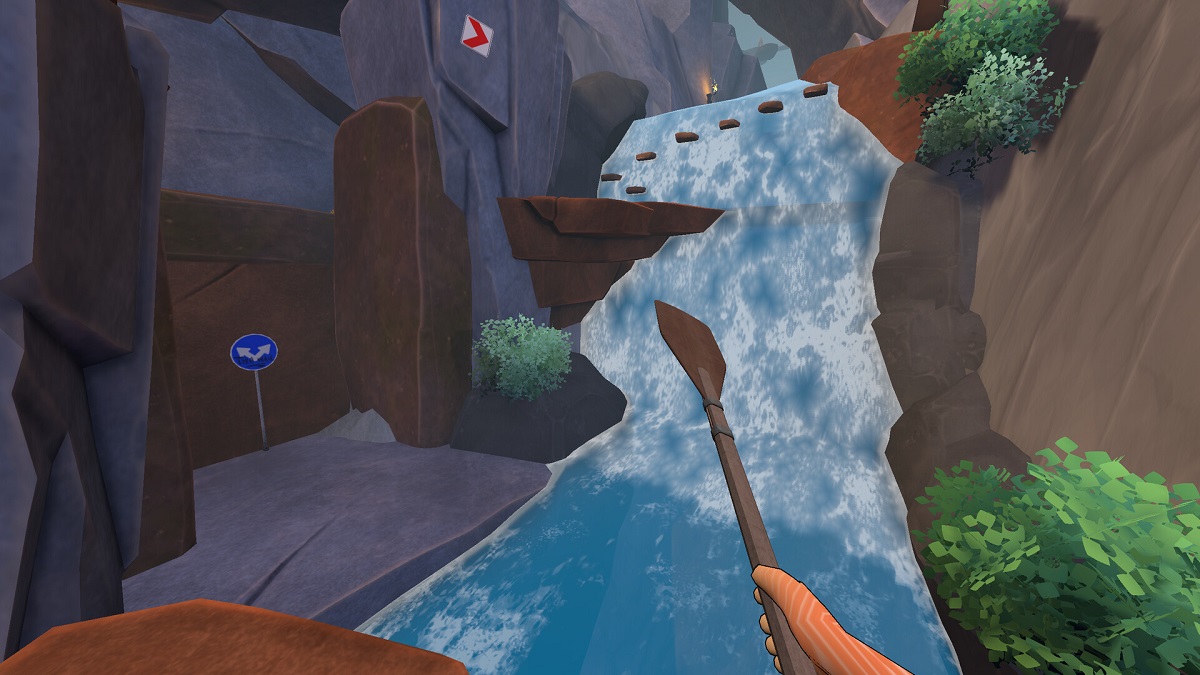
Salmon Man on Meta Quest isn’t just another VR platformer – it’s a gauntlet designed to provoke equal parts frustration and triumph. From the second you grip your paddle and are launched into a world of absurd upstream challenges, the game makes clear that mastery is its own reward. Movement is governed entirely by physics-based paddle propulsion, forcing you to judge depth, momentum, and angle with precision; when you finally execute a tricky sequence it feels purely earned, but one tiny misjudgment can undo minutes of progress in a heartbeat. This unforgiving “upstream or nothing” design gives the game an emotional rhythm that, like classic rage titles, blends anxiety and satisfaction in near equal measure.
What stands out most about Salmon Man’s mechanics is how they amplify both immersion and challenge in VR. There’s no smooth locomotion or comfort options to soften the experience: you’re physically swinging, bracing, and launching yourself with that single paddle across vertical terrain that demands spatial awareness and careful control. The physics feel intentional and consistent for the most part, so skilled players can learn and refine techniques to shave seconds off their runs – yet the same system can frustrate when depth perception, tracking or momentum doesn’t quite cooperate. These tight mechanics make for excellent speedrunning opportunities, and the included leaderboards and optional challenges add real replay value, though the notoriously steep learning curve may be off-putting for those expecting a more casual climb.
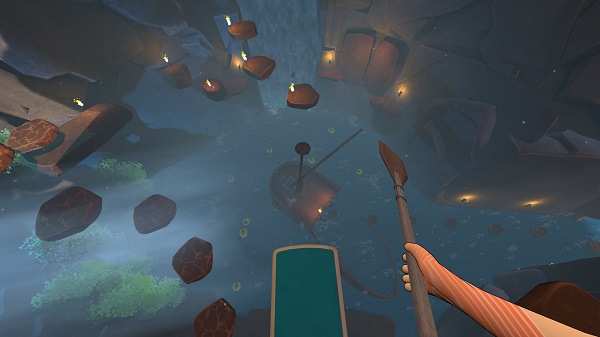
Visually and audibly, the world has a playful absurdity but stops short of immersive spectacle. The environments are colourful and quirky – there’s a humorous twist to scaling absurd obstacles – yet the graphical simplicity and minimal ambience mean much of the immersion must come from your own engagement with the challenge itself rather than from scenic wonder. There’s little narrative beyond the implicit “salmon heading upstream” conceit, and music is sparse; this makes the journey feel lean and focused on mechanics, but it also leaves the experience feeling a bit bare for players who enjoy more atmospheric or story-led VR titles.
That lean design is part of the game’s identity, and it both defines Salmon Man’s appeal and limits its audience. For dedicated players who relish precision, repetition, and the emotional highs of overcoming a punishing obstacle, there’s a deeply satisfying core here. Each small victory unlocks new paths to explore or records to beat, and the sense of progression – even when hard-won – keeps you engaged. On the flip side, the lack of onboarding, checkpoints, or accessibility options means that newcomers to VR or physics-heavy platformers might find the early experience opaque and overwhelming. In the end, Salmon Man isn’t a universally comfortable VR romp so much as a finely tuned challenge: one that rewards perseverance and punishes haste, leaving you with memories of triumphant climbs alongside plenty of near-miss frustrations.
The Stairwell review (PS5)
There’s a satisfying strain of obsessive focus at the heart of The Stairwell, a vertical anomaly horror game that often feels deceptively simple on the surface but consistently rewards close inspection and pure curiosity. On PS5, the first-person loop structure nails that uncanny blend of routine and dread better than many of its peers: you’re repeatedly climbing toward the elusive rooftop while scanning near-identical floors for subtle departures from “normal.” The atmosphere here leans into creeping paranoia over cheap frights, and while there are occasional jumpscares if you choose to leave them enabled, the unsettling tension comes mostly from uncertainty and micro-differences in the environment.
Mechanically, The Stairwell is built around patience and detailed observation. There are over fifty anomalies tucked across the game’s difficulties, some so subtle they genuinely make you question what you remember seeing just moments before. Certain larger, more playful anomalies – from bizarre mannequins to surreal environmental shifts – provide texture alongside the more understated ones but never overshadow the core loop: notice something off, then descend and see if your instincts were right. In addition, Nightmare mode’s candlelight exploration introduces a tense but welcome variation.

The controls are intuitive throughout, and the PS5’s DualSense features – particularly vibration support – subtly enhance the tactile feel of each floor. There’s no combat to clutter the experience; instead, the game trusts you to react with your eyes and instincts alone. The narrative here is lean, mostly implied through small visual cues and recurring characters, but it gives just enough personality to make the stairwell’s eeriness feel purposeful rather than repetitive.
Visually, The Stairwell isn’t going to win technical awards, but it uses its modest aesthetic wisely, making everyday objects and repeated corridors feel uncanny rather than generic. The sound design and music contribute strongly to the tension without ever becoming intrusive, and the overall package is polished with thoughtful options like toggling jump scares or customizing difficulty. There are moments where the pacing drags a little, and players new to anomaly detection might find the subtleties frustrating, but for those who thrive on attention to detail and atmosphere over spectacle, this is among the more rewarding entries in the genre.
Ship’s Cat review (PS5)
What begins as a cozy cat-on-a-cruise premise quickly reveals itself to be something a bit stranger aboard Ship’s Cat, the PS5 adaptation of Caddy Computing’s indie oddity. You’re cast as the titular feline pest controller on the world’s first nuclear-powered passenger ship, tasked with keeping rodent populations in check while exploring cabins, kitchens, lounges and grimy service corridors from a distinctly low-to-the-ground perspective. That setup lends the game a quirky narrative identity that straddles humour and the faintest whisper of mystery – passengers chat in oblivious banter, mini games like golf and waterslides pepper the journey, and every now and then the tone dips into mild spookiness as the ship’s underbelly starts to feel just a bit off. There’s a charm in seeing the ordinary through cat eyes here, even if the story never pushes much beyond its initial setup.
Mechanically, Ship’s Cat wears its accessibility on its sleeve. Movement through the ship is straightforward and forgiving, with simple exploration and light interactions dominating the play loop. Basic abilities – from tracking rodents to extended leaps – arrive gradually and make backtracking feel slightly less like padding in circles and more like purposeful progression. The controls themselves are intuitive but rarely surprising; rodent encounters feel more slapstick than strategic, and while the simplicity has its appeal, veterans of action-adventure titles may find the core gameplay lacking in depth or variation. The occasional tonal shifts – creeping shadows or flickering corridors – provide texture, but they never evolve into anything that seriously tests skills or crafts long-term mechanical satisfaction.
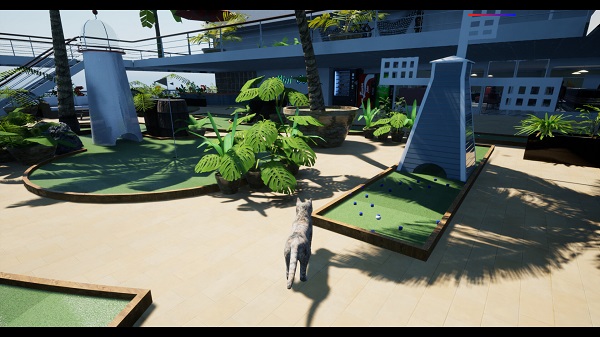
Visually and aurally, the PS5 version leans into the heart of a solo-dev effort. Character models and textures are functional rather than flashy; animations can be stiff at times, and certain corridors or cabins lack the polish you’d find in higher-budget productions. Yet there’s a tangible sincerity to the ship’s design that helps sell the setting more effectively than dazzling graphics ever would. Sound design is subtle but deliberate – creaking bulkheads, distant engine hums, and elevator music give the vessel personality, even if a more varied score might have elevated moments of tension or whimsy. The audio works with the visuals to create a grounded, if modest, sense of place throughout the voyage.
Ultimately, Ship’s Cat on PS5 is a niche indie curiosity that will resonate most with players open to gentle explorations and lighthearted mood over deep systems or dramatic narratives. Its modest production values and repetitive objectives keep it squarely in “pleasant diversion” territory, but its atmospheric setting, accessible controls, and occasional surreal humour make it an easy recommendation for younger players or those seeking a relaxed, offbeat experience between heavier games. The game’s ambition never pretends to be blockbuster-scale, but there’s genuine heart in seeing a massive, slightly unsettling passenger ship through whiskers and curiosity.
 Press Play Media