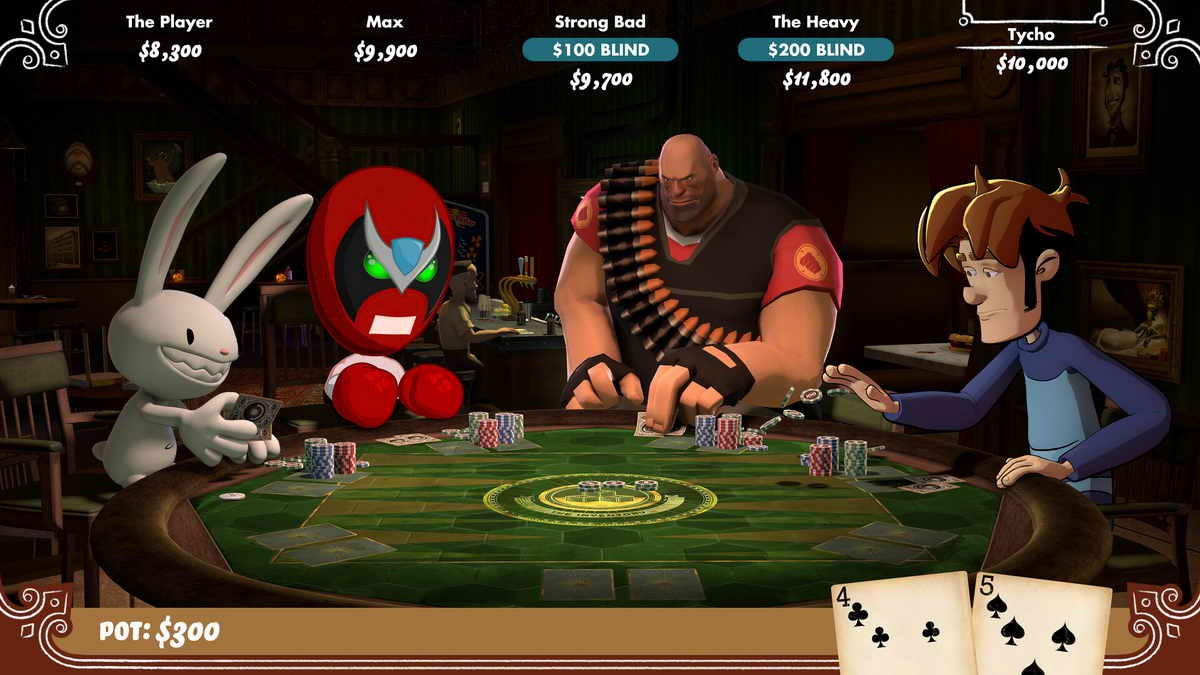
Originally released in 2010 as a quirky side project from Telltale Games, Poker Night at the Inventory was always something of an oddity – a crossover comedy where characters from different corners of gaming culture gathered around a poker table for an evening of banter and bluffing. Now remastered by Skunkape Games, a studio formed by former Telltale developers, the game returns with a fresh coat of paint and a new console audience. The premise remains as delightfully simple as ever: you sit down in a mysterious underground club to play Texas Hold’em against a strange mix of personalities – Max from Sam & Max, Strong Bad from Homestar Runner, Tycho from Penny Arcade, and the Heavy from Team Fortress 2. What follows isn’t a story-driven adventure but a conversational card game where the true entertainment comes from the personalities around the table rather than the stakes in the pot.
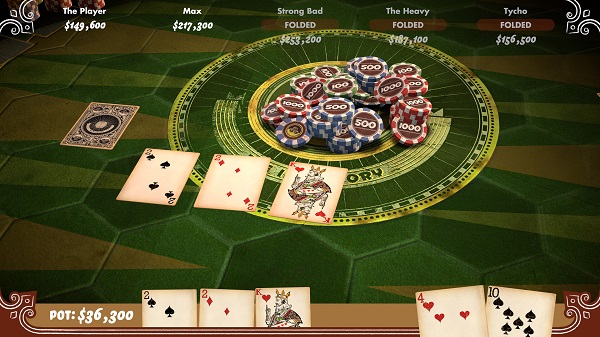
Mechanically, the game is exactly what the title promises: a straightforward simulation of No Limit Texas Hold’em played in a tournament-style format. You call, raise, fold, and bluff your way through rounds until only one player remains standing. The remastered version improves the core poker simulation compared to the original release, with more accurate rule handling and AI that tends to behave in ways that better match each character’s personality and playstyle. For players who enjoy poker, this adds welcome depth, as reading opponents and spotting bluffs becomes an important part of the experience. At the same time, the limited scope means there isn’t much beyond this single mode, so those hoping for multiple rule variations or a deeper progression system may find the overall package a little thin.
What keeps the experience engaging is the game’s constant stream of dialogue. The four opponents rarely sit quietly, instead trading insults, anecdotes, and absurd tangents that reflect their respective franchises. Max’s unpredictable chaos, Tycho’s dry sarcasm, Strong Bad’s self-aware arrogance, and the Heavy’s blunt humor all play off each other in amusing ways, creating the feeling of a lively poker night rather than a solitary card game. The writing often lands its jokes well, but repetition eventually sets in during longer sessions, as the same stories and punchlines start resurfacing after enough tournaments.
Progression comes primarily through collectibles and unlockables. Winning tournaments can earn players new card decks, table designs, and occasionally special items that opponents wager when they run low on chips. These rewards provide a small incentive to keep returning to the table, though the core loop doesn’t evolve much over time. If you enjoy learning the nuances of poker strategy or chasing unlockables, the replay value is there, but the structure remains deliberately simple – essentially an endless series of poker nights rather than a broader campaign with goals and format changes.
Visually, the remaster does a solid job updating a game that originally came from the early 2010s. Character models have been rebuilt at higher resolutions, and the lighting and environmental details around the smoky backroom table have been noticeably improved. The presentation still leans heavily into the stylized designs of its source franchises, which means the visuals are more charming than cutting-edge. On PS5 the game runs smoothly and feels well suited to a relaxed couch session, though the small scale of the environment means you’ll spend the entire game staring at the same table from roughly the same perspective.
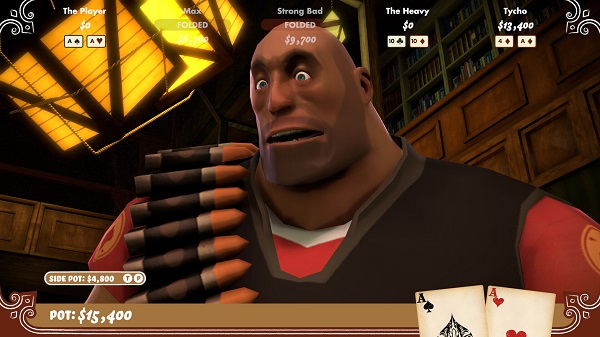
Audio plays a major role in selling the experience. The voice acting is strong across the board, with each character sounding authentic to their original portrayals and delivering the rapid-fire dialogue with enthusiasm. The background music is understated and largely fades into the background, letting the conversations take center stage. That works well for the game’s atmosphere, though the limited soundtrack means the audio landscape can feel sparse during extended play sessions.
Ultimately, Poker Night at the Inventory remains what it always was: a novelty concept executed with charm. The remaster modernizes the presentation and smooths out the poker mechanics without fundamentally changing the structure of the game. For fans of the characters involved – or players who simply enjoy a casual game of cards with some comedic flavor – it’s an easy recommendation. Those looking for a more expansive poker simulation or a deeper campaign experience may find its simplicity wearing thin after a few evenings at the table, but as a lighthearted crossover and a nostalgic slice of early Telltale creativity, it still holds a surprisingly strong hand.
Score: 7.3/10
 Press Play Media