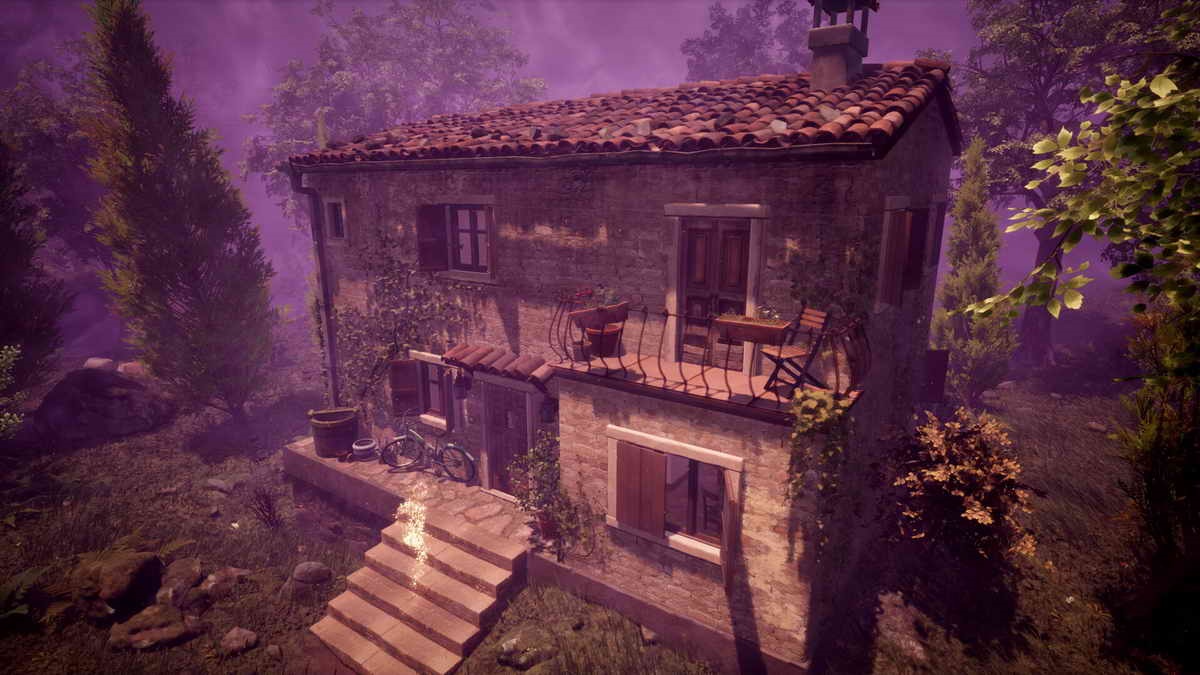
In this interview, we speak with the team at Selkies Interactive about their upcoming narrative adventure Echoes of Mora. Set in a mysterious sunken village and playable both in VR and on traditional PC setups, the game follows a young girl searching for her missing brother while players interact with the past through time-spanning “Echoes.” Our conversation explores how the developers shaped the game’s unusual perspective – placing players in the role of an unseen guide communicating with Mora – while also discussing the challenges of designing meaningful VR movement, balancing scope as a debut indie project, and building an emotionally grounded story about family, folklore, and growing up.
The central mechanic of communicating with Mora across time positions the player as both observer and participant. Was it always the intention to give players that “invisible guardian” role, or did that emerge organically?
The “invisible guardian” role was not part of the original vision from the very beginning. As we continued to develop the concept, experimented with different interactions in VR, and shaped the narrative, we realized that experiencing the story through conventional cutscenes felt quite dull in VR. We wanted players to feel truly present and as though they were participating in the events. That’s why we decided to give the player the ability to communicate with Mora, become part of her journey, and influence how the story unfolds. Based on this feature, we then finalized the script and continued with production.
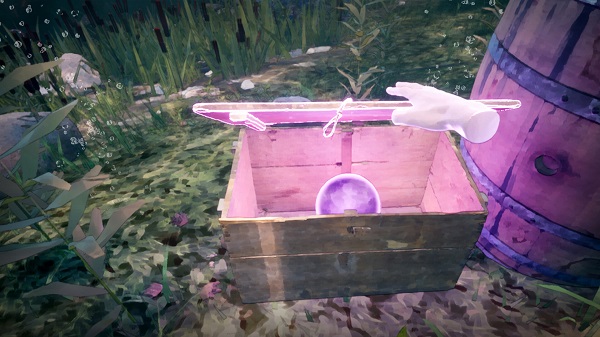
Developing simultaneously for traditional PC play and full VR is ambitious. Did you begin with one format as the “primary” version, or were both platforms considered equal pillars from day one?
Echoes of Mora started out as a VR project, but halfway through production, we introduced a PC mode to streamline debugging and testing. We quickly realized that this mode offered a great experience in its own right and decided to offer it as a mode of play. This has enabled us to broaden the audience considerably, while giving players the freedom to choose how they play.
Swimming via motion-tracked arm movements and interacting with things in VR introduces a very physical layer to exploration. What were the biggest design challenges in making sure that physicality translated meaningfully to gameplay rather than feeling like a novelty?
At the beginning of developing the concept for Echoes of Mora, we first asked ourselves what immersive movement in VR could look like. We weren’t big fans of teleporting or joystick locomotion, as they often feel artificial and can cause motion sickness for many people. So we looked for a movement system that felt natural and physically grounded. Swimming was the obvious choice. It supports embodiment, the feeling that the virtual body is your own, because your real movements match what you see in VR.
In everyday life, you usually don’t feel sick when your body and your vision align, but you might when they don’t, like reading in a moving car. Swimming with your own arm movements helps avoid that disconnect. Once we committed to swimming, an underwater setting made sense. But we didn’t want to build a typical diving simulator. We were inspired by the image of the lone church tower rising out of Lake Reschen in South Tyrol, a real submerged village, and that became the starting point for our story.
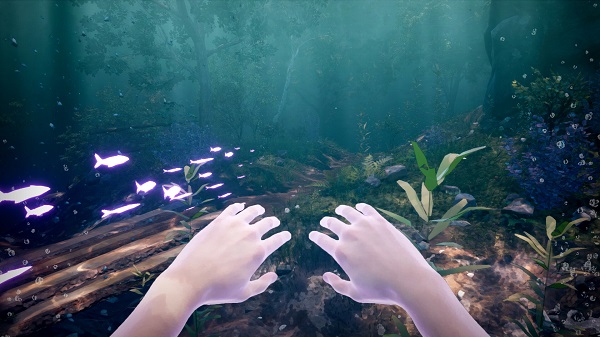
Exploration and collecting felt like natural activities in that space. In the game, players find “Fragments” that open portals to the past, letting them experience the world before it was flooded (while also giving their arms a brief break). Technically, the biggest challenge was the swimming system itself. We tried different tracking approaches: from detecting pre-recorded movement samples, to reading inputs in real time and comparing them to preset variables, and finally using vectors to calculate swimming direction and speed. While the VR mode is about physical embodiment and the ‘feel’ of the water, the PC mode focuses on the atmosphere and the ease of exploration, ensuring the story remains the star of the show regardless of how you play.
As an indie studio, how did you prioritize scope – particularly with a feature set that includes narrative branching, environmental puzzles, and dual-platform functionality?
As a debut game, Echoes of Mora was an ambitious project. To manage scope effectively, we moved away from ‘feature creep’ and focused on refining the core experience to make the game feel special. We intentionally chose to prioritize the atmosphere and emotional weight of the story over unnecessary complexity.
For our narrative branching, we emphasize character dialogue. While the overarching story follows a clear path, the player’s decisions, such as where to begin the search for Dario, directly shape the game’s endings. This allowed us to deliver a narrative that feels personal and significant without losing the pacing. Ultimately, our priority was delivering an enjoyable experience for our players. We believe that successfully releasing a first game is far more important than chasing an overly ambitious project that might never see the light of day.
The sibling relationship feels central and emotionally grounded. Was this inspired by personal experiences, folklore, or specific literary influences?
The narrative was indeed inspired by our own childhood experiences. We know what it’s like to be the younger sibling following the older one, with that mix of admiration, curiosity, and frustration. A story about a complicated sibling relationship feels timeless, even though it’s set in Italy in the 1960s. We hope this coming-of-age story resonates with many players, no matter their background or culture.
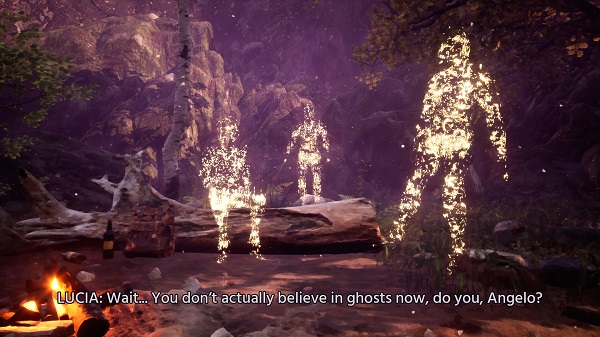
The story explores relationships among children, teens, and adults, examining differences across generations, clashes with tradition, and the desire to break free. It is not a simple tale of good versus evil. Everyone acts based on how they were raised and what they were taught. By showing different perspectives, we wanted the story to feel grounded and emotionally complex.
Mora being a child is also important for making the supernatural elements believable. Like many of us, we grew up hearing stories and folklore that we fully believed in as children. We drew on European folklore and superstitions, often intended to keep children safe, such as warnings to stay away from a “cursed lake”. We wanted to capture that feeling of being warned as a child about danger, while still being fascinated by the supernatural. The demo that is out only shows a small slice of Mora’s story, but even there, you can already see how relationships, different perspectives, and generational tensions shape the world. In the full game, there will be much more to discover.
How have early hands-on impressions shaped your iteration process so far?
Whenever we exhibit Echoes of Mora at trade shows, we always come prepared with a pen and notebook in hand! Gathering feedback and playtesting the game are at the core of our development process. The game’s development has always been an iterative process, which is why we reworked the swimming system multiple times, for example. We are also very grateful for our amazing community and the vibrant network at DE:HIVE, as having fellow game design students to help with playtesting has been invaluable. Although the initial concept changed primarily due to the addition of the PC mode, we cannot deny the positive influence that others have had on the implementation of the concept and even the story.
 Press Play Media