
Ports are a common way for games to find new audiences, as developers revisit projects that originally launched on other platforms. Whether it’s bringing a VR experience to new hardware or adapting smaller indie titles for consoles, these releases often give players another chance to discover games they might have missed the first time around. In this roundup, we’re taking a look at three such arrivals on PlayStation hardware: the rhythm-focused DrumBeats VR on PSVR2, the exploration-driven shooter Minishoot’ Adventures on PS5, and the arcade-style aerial combat of Warplanes: WW2 Dogfight.
DrumBeats VR review (PSVR2)
Rhythm games have long been a natural fit for virtual reality, and DrumBeats VR leans fully into that idea by putting players behind a full drum kit rather than turning the experience into a flashy arcade spectacle. Developed by Marcel Eissens and published by MESHm, the game focuses on recreating the sensation of performing as a drummer, asking players to follow note patterns across a realistically arranged kit while songs play in the background. Instead of stylized gestures or exaggerated movements, the mechanics encourage players to strike specific drums and cymbals in ways that resemble real drumming, which helps sell the fantasy of being the rhythmic backbone of a band. That approach gives the game a slightly steeper learning curve than some rhythm titles, but it also creates a sense of authenticity that many VR music games lack.
Gameplay revolves around hitting incoming note prompts across the drum kit with the PSVR2 Sense controllers, with accuracy and timing determining your score. The layout mirrors a real kit, which means players must quickly shift between snares, toms, cymbals and kick patterns in ways that feel surprisingly natural once everything clicks. One of the most interesting additions in the PSVR2 version is optional bass-drum pedal support through compatible racing wheel pedals, letting players physically tap a foot pedal for kick hits rather than relying on controller buttons. It’s a clever touch that enhances the illusion of sitting behind a real drum set, although most players will still (have to) rely on more traditional controls. Difficulty settings, speed modifiers and optional gameplay tweaks provide some flexibility, and there’s also a free-play mode for simply experimenting with the drum kits and environments.

Visually, DrumBeats VR opts for straightforward environments rather than extravagant concert stages, but the variety of settings – ranging from studios to more surreal locations like the moon or the ocean floor – helps keep sessions visually fresh. The presentation is functional rather than spectacular, yet the immersion comes primarily from the act of drumming itself. Audio is where the game shines most consistently: drum sounds are crisp and punchy, and striking different parts of the kit produces convincing variations that reinforce the illusion of playing real instruments. That said, hit detection and timing feedback can be inconsistent, which can occasionally make precise rhythms feel slightly off, especially in faster songs.
Content-wise, the base track list is relatively modest at just over twenty songs, which can make the game feel limited compared to more established rhythm titles – especially if you prefer playing to licensed tracks. Fortunately, the developer has promised support for custom songs, allowing players to expand the soundtrack and keep the experience fresh over time – something that significantly improves the game’s long-term appeal for those willing to dive into user-created content. Even with its quirks and occasional technical rough edges, DrumBeats VR offers an engaging take on VR rhythm gameplay that prioritizes authenticity over spectacle. It may not be the most polished drumming game on the market, but for players who enjoy the idea of stepping into a drummer’s role rather than simply hitting beats in mid-air, it provides a satisfying and surprisingly immersive musical playground.
Minishoot’ Adventures review (PS5)
Minishoot’ Adventures blends a surprising set of ideas into something that feels immediately familiar yet distinct: a top-down shooter wrapped in the exploratory structure of a classic adventure game. The setup is straightforward but effective, casting players as a small spaceship setting out to rescue friends trapped in crystal after a destructive attack by a mysterious villain. The narrative itself remains fairly lightweight and mostly serves as motivation to keep exploring, but it works well enough as a framework for a journey that steadily expands in scope as new abilities are discovered and new areas open up.
What makes the game stand out is how naturally it merges bullet-hell shooting with the curiosity-driven exploration of an adventure game. Instead of moving through linear stages, players wander a handcrafted world full of shortcuts, hidden upgrades, and secret encounters, gradually unlocking powers that open previously inaccessible routes. Combat starts relatively simple but quickly evolves as enemy patterns grow denser and bosses introduce more elaborate bullet patterns. The result is a satisfying rhythm where tense shootouts are balanced by quieter moments of discovery, though some encounters rely heavily on wave-based arenas that can briefly interrupt the sense of freeform exploration.
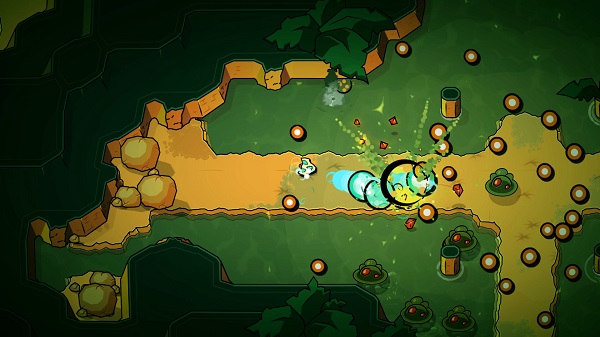
The controls on the PS5 version are a major strength, especially on a controller where the twin-stick setup feels responsive and precise. Maneuvering through bullet patterns while lining up shots remains consistently satisfying, and the gradual upgrade system ensures the ship becomes more capable without ever feeling overpowered. Difficulty settings and accessibility options also make the experience adaptable for different skill levels, though some players may find that early sections feel a bit slow before meaningful upgrades start to accumulate.
Visually, Minishoot’ Adventures leans into a clean, colorful aesthetic that complements its playful tone, with clearly readable environments and enemy attacks that help maintain clarity even when the screen fills with projectiles. The world design encourages constant exploration, with charming environments and plenty of secrets to uncover, although certain areas can look somewhat similar as the adventure progresses. Combined with energetic sound design and music that keeps the pace lively during combat, the presentation helps give the game a distinct identity. It’s a compact but memorable adventure that successfully merges genres rarely seen together, delivering a satisfying mix of exploration and action even if its story remains mostly in the background. A surprise indie hit that shouldn’t be missed.
Warplanes: WW2 Dogfight review (PS5)
World War II air combat has inspired countless games over the years, and Warplanes: WW2 Dogfight takes a relatively accessible approach to the genre. Rather than aiming for a hardcore flight simulation, the game focuses on arcade-style aerial combat combined with a light management layer. Players step into the role of both pilot and squadron leader, flying missions across several wartime factions while recruiting pilots, upgrading aircraft, and expanding their base of operations. While this framework creates a sense of progression beyond individual missions, the experience largely revolves around short combat scenarios rather than a broader narrative campaign, which can make the overall structure feel somewhat mechanical despite the appealing premise.
Once airborne, the game emphasizes accessibility. Controls are straightforward and easy to grasp, allowing players to lock onto enemy targets, fire machine guns, and deploy secondary weapons without wrestling with complicated flight mechanics. This simplicity makes dogfights immediately enjoyable, and chasing down enemy aircraft while managing overheating weapons can be genuinely exciting. At the same time, the flight model is fairly limited, with few advanced maneuvers available and a generally simplified sense of aircraft handling. As a result, the game captures the thrill of aerial combat but rarely the nuance, making it feel more like an arcade shooter than a traditional flight sim.

Between missions, Warplanes introduces a surprisingly robust management layer where players recruit pilots, acquire new planes, and upgrade both aircraft and base facilities. Building a larger squadron and assigning pilots to specific tasks adds a strategic element that can make later battles feel more dynamic, especially when commanding multiple aircraft in a single engagement. However, the progression system can feel somewhat uneven, and its origins as a mobile game occasionally show through in the way resources and upgrades are structured. Missions also tend to repeat familiar objectives – dogfights, bombing runs, and defense scenarios – which means the novelty can wear off after a few hours despite the variety of planes and upgrade paths available.
Visually, the game delivers mixed results. The aircraft models themselves are nicely detailed and benefit from customization options, while the environments and terrain tend to look comparatively basic. Audio and radio chatter help sell the atmosphere of aerial warfare, but the presentation overall remains fairly modest. Even so, the core appeal lies in the accessible dogfighting and the steady loop of unlocking aircraft and improving your squadron. Warplanes: WW2 Dogfight may lack the depth or narrative drive of larger flight combat games, but as a pick-up-and-play arcade experience it offers an enjoyable way to spend a few hours in the cockpit.
 Press Play Media