The indie scene rarely slows down, and the latest batch of smaller releases once again shows how developers continue to experiment with familiar genres in compact, approachable ways. From traffic-untangling logic puzzles and inventive platforming mechanics to retro-inspired adventures starring unlikely heroes, these titles lean into straightforward concepts while putting their own twists on well-worn ideas. None of them aim for sprawling blockbuster scope, but each offers a quick, focused experience that highlights the creativity and accessibility that have long been hallmarks of the indie space. In this roundup we take a closer look at Avenue Escape, 1 CatLine, and Adventurous Slime, three budget-friendly PS5 releases that each deliver their own take on puzzle solving and platforming.
Avenue Escape review (PS5)
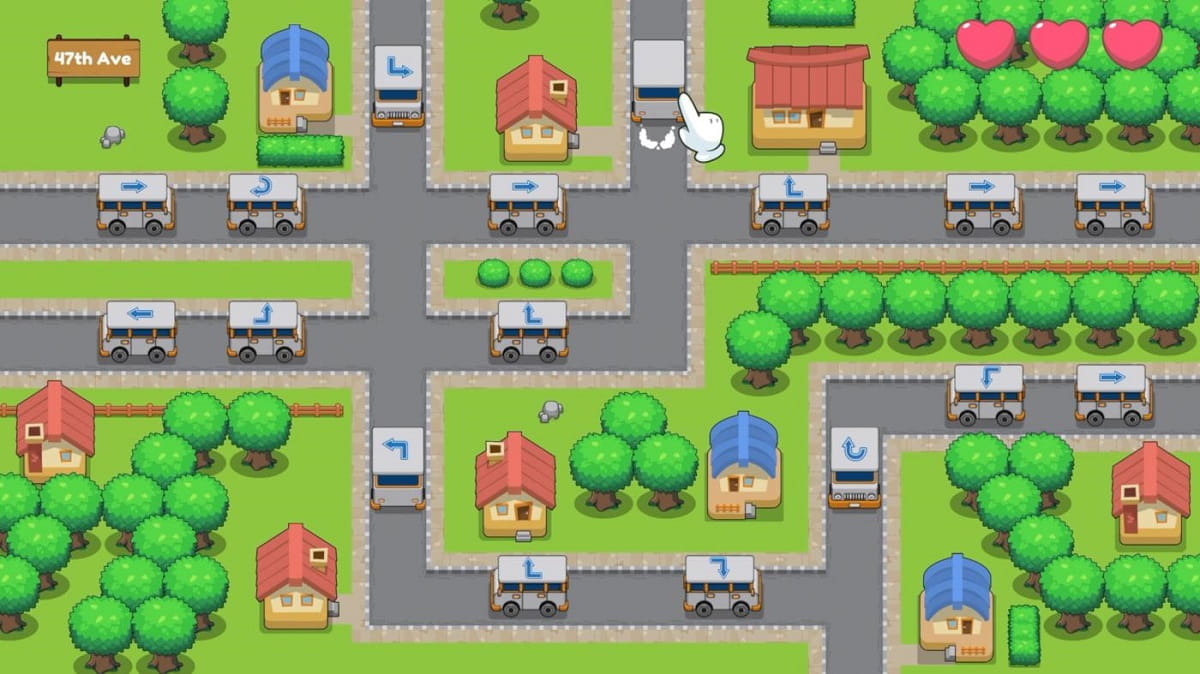
Puzzle games often thrive on simple concepts executed well, and Avenue Escape certainly embraces that philosophy. Developed by Double Mizzlee and published by Eastasiasoft, the game presents a series of compact urban puzzles where players must untangle traffic jams by activating vehicles in the correct order. Each level places cars on predetermined paths through a grid of streets, and the challenge lies in figuring out which vehicles to move first so that collisions are avoided and every driver reaches their destination safely. It’s a premise that’s easy to grasp within seconds, making the game immediately approachable, though it also means that Avenue Escape rarely aims for anything beyond straightforward logic puzzles.
The core gameplay revolves around studying the layout and triggering vehicles one by one while anticipating how their routes intersect. Cars move automatically once activated, so success depends on careful sequencing rather than quick reflexes. Pedestrians crossing the road occasionally complicate the process, forcing players to wait for safe moments before sending vehicles on their way. While this extra layer does introduce some variety, it doesn’t dramatically change the underlying puzzle structure and sometimes feels more like a minor delay than a meaningful strategic wrinkle. Still, the puzzles are generally intuitive and accessible, making them easy to pick up for short play sessions even if they rarely become especially intricate.
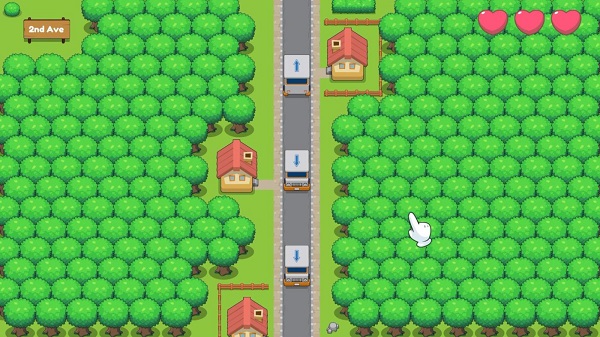
Controls are straightforward and well suited to the game’s design, allowing players to select vehicles quickly and experiment with different solutions without friction. Because failed attempts reset quickly, the trial-and-error approach becomes part of the learning process rather than a source of frustration. Visually, Avenue Escape adopts a bright, clean style that prioritizes readability, making it easy to identify vehicles and their directions at a glance. The presentation does its job effectively, though it’s undeniably minimalistic, and the audio follows a similar pattern with serviceable sound effects and background music that help fill the space without leaving a lasting impression.
Where Avenue Escape ultimately struggles is in maintaining momentum beyond its initial novelty. With around fifty stages to clear, the core mechanic remains largely unchanged from beginning to end, and puzzle variations are limited enough that the experience can begin to feel repetitive. The simplicity that makes the game accessible also makes it feel closer to a casual mobile puzzler than a console experience designed for longer play sessions. As a quick, low-pressure brain teaser it can still provide a brief distraction, but those hoping for deeper mechanics or evolving challenges may find that the traffic clears a little too quickly for its own good.
1 Catline review (PS5)
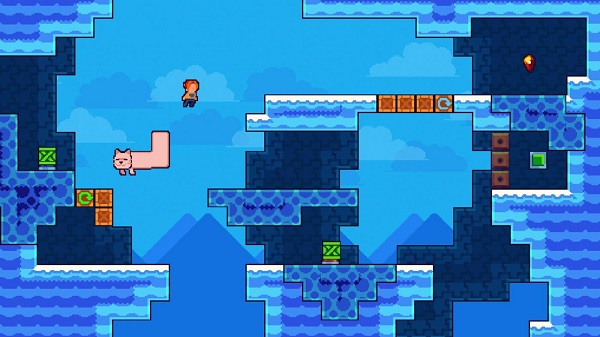
Published by Eastasiasoft and developed by Nerd Games, 1 CatLine takes a simple premise and wraps it around a clever puzzle-platforming twist. The game places players in control of a nimble heroine tackling a series of compact, single-screen stages where the goal is usually to reach an exit or collectible gem. The twist comes from a feline companion that acts as both a puzzle tool and a physical platform, capable of stretching across gaps and interacting with switches or objects in ways the protagonist cannot. It’s a playful idea that immediately sets the game apart, though the premise itself remains light and functional rather than narrative-driven. Instead, the focus is firmly on solving spatial puzzles and figuring out how both characters can cooperate to navigate each tightly designed stage.
Gameplay revolves around precision platforming combined with puzzle logic, with most levels requiring careful planning rather than pure reflexes. At key moments you can freeze time mid-jump to reposition the cat, effectively turning it into a bridge, staircase or switch activator before landing. It’s a satisfying mechanic that encourages experimentation, especially as later stages introduce rotating platforms, portals and other twists that build on the core idea. Because each level fits on a single screen, challenges stay focused and solutions rarely feel overly complicated, keeping the pacing brisk and approachable. That said, the central gimmick sometimes carries more of the game than its surrounding systems; several puzzles end up relying on similar “cat staircase” solutions, and while clever variations appear, the mechanical depth doesn’t expand dramatically beyond that core concept.
Controls on PS5 are responsive and easy to grasp, which is essential for a game that asks players to coordinate jumps, switches and character swapping with precision. Restarting levels is instant, making trial and error feel like part of the puzzle-solving process rather than a punishment. This quick iteration loop works well, especially when tackling later stages that require more careful spatial planning. However, the overall experience is fairly short – the roughly fifty levels can be cleared in just a few hours – and while that compact runtime keeps the game from overstaying its welcome, it also means the mechanics never quite reach their full potential before the adventure wraps up.
Visually, 1 CatLine leans into colourful retro-inspired pixel art that suits its puzzle-box design, with small biomes and clean layouts that make it easy to read the environment at a glance. The camera occasionally shifts perspective when controlling the cat, subtly helping players understand the spatial relationship between platforms and switches. It’s a charming presentation overall, supported by simple but fitting audio that keeps the focus on solving puzzles rather than spectacle. Ultimately, 1 CatLine is a neat and inventive budget puzzler built around a genuinely fun mechanic, even if it sometimes leans a little too heavily on that single idea. For players looking for a short, creative platforming challenge rather than a sprawling adventure, it delivers a concise but enjoyable experience.
Adventurous Slime review (PS5)
Small-scale retro platformers have become a staple of the indie scene, and Adventurous Slime fits comfortably into that tradition. Developed by lightUP and brought to consoles by Ratalaika Games, it casts players as a surprisingly brave little slime who sets out to stop the ominously named Lord Old Skull after the villain threatens a peaceful magical land. The narrative framework is intentionally light, leaning into the kind of simple “save the world” premise common to classic platformers rather than delivering elaborate storytelling. That simplicity works reasonably well for a game of this size, giving the adventure a playful tone, though it also means the story rarely becomes more than a backdrop for the action.
The gameplay follows a familiar metroidvania-inspired structure built around side-scrolling exploration, jumping challenges, and combat against enemies scattered across four different biomes. Alternative routes and hidden areas encourage exploration, which helps make the compact world feel slightly larger than its modest runtime suggests. Light RPG elements such as experience gains and collectible upgrades add a small sense of progression, while spells and mobility upgrades gradually expand what the slime can do. At the same time, the mechanics remain quite traditional, and the overall difficulty tends to stay on the forgiving side. Boss fights provide some highlights, though they can feel uneven in challenge and relatively straightforward once their patterns are understood.
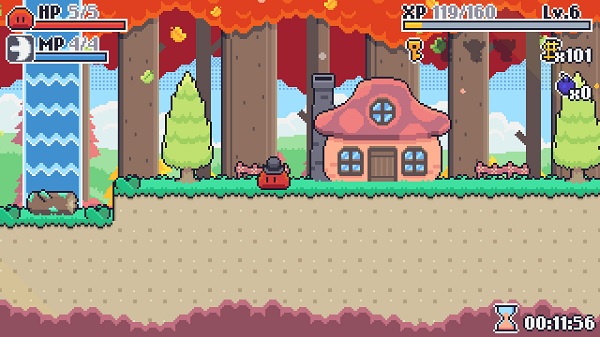
Controls generally feel responsive and well suited to the game’s platforming focus. Movement and jumping are predictable, which makes navigating hazards and environmental obstacles feel fair most of the time. Combat is similarly accessible, offering both physical and magical attacks to deal with enemies. However, the arc of the slime’s melee strike can occasionally make aiming a little awkward, sometimes encouraging players to rely on ranged spells instead. Progression systems also show some rough edges, with experience gains arriving at a slow pace if players aim to fully level up.
Presentation is where Adventurous Slime arguably shows its most consistent charm. The pixel-art visuals embrace a colourful retro aesthetic, and the animated slime protagonist has plenty of personality thanks to its squishy movements and expressive design. Environments are bright and readable, even if they remain fairly simple in detail. The chiptune soundtrack complements the visuals nicely and gives each biome its own identity, reinforcing the nostalgic tone the game aims for. Ultimately, Adventurous Slime doesn’t push the genre forward in any significant way, and its short runtime means the adventure is over quickly. Still, for players looking for a relaxed, cheerful platforming experience that delivers a few hours of light exploration and retro-style action, this slime-sized quest manages to be a pleasant little diversion.
 Press Play Media