
In today’s port roundup, we revisit games like Basketball Classics, Disgaea 7 Complete, and PULMO. Each approaches its transition differently: one leans into nostalgia with only light-touch enhancements, another arrives as a feature-rich definitive edition, and one attempts to reframe its original ideas for a new audience entirely. The result is a varied snapshot of how games age, evolve, and occasionally struggle under the weight of their own ambitions when brought into a new generation.
Basketball Classics review (PS5)
Basketball Classics arrives on PlayStation 5 several years after its initial PC debut, positioning itself as a love letter to the side-scrolling sports games of decades past while attempting to layer in modern sensibilities. Its premise is deliberately straightforward, focusing less on narrative or campaign-like framing and more on recreating the spirit of pick-up-and-play basketball from the 8-bit era. What emerges is a title that leans heavily on nostalgia, but also tries to ground itself with deeper systems like player attributes and expanded rosters, creating an experience that sits somewhere between arcade immediacy and simulation-lite ambition.
On the court, the three-button control scheme is immediately approachable, allowing newcomers to jump into matches without friction, yet there’s more nuance beneath the surface than expected. Dynamic play-calling introduces a tactical layer that rewards timing and positioning, giving matches a rhythm that goes beyond simply sprinting and shooting. That said, the simplicity can occasionally work against the game, with animations and responsiveness sometimes lacking the precision needed for consistently tight control, especially during more chaotic moments. While the fundamentals are solid, the balance between accessibility and depth doesn’t always feel perfectly tuned.
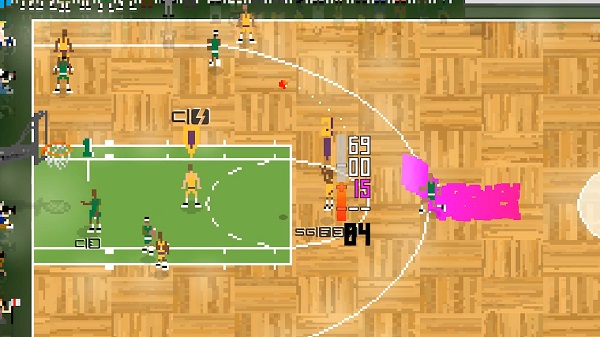
The breadth of content is one of the game’s stronger pillars, with a wide selection of teams and players spanning multiple eras, each carrying distinct statistical profiles. This lends a sense of authenticity and variety, particularly for players who enjoy experimenting with different lineups. The story mode adds some structure through unlockables and progression, though it remains fairly light in terms of narrative engagement. Local multiplayer stands out as a highlight, capturing the competitive, high-energy feel that clearly inspired the project, even if the overall presentation occasionally struggles to maintain that same level of excitement in solo play.
Visually and audibly, Basketball Classics commits fully to its retro identity, delivering pixel-art aesthetics and sound design that echo classic sports titles. This stylistic consistency is effective in reinforcing its nostalgic appeal, though it can also feel limiting, particularly when paired with somewhat repetitive audio cues and modest visual variety over extended sessions. Performance on PS5 is stable, but the underlying design shows its indie roots, with some rough edges in UI polish and presentation. Ultimately, Basketball Classics succeeds most when embraced as a throwback experience with modern tweaks, even if its ambitions occasionally outpace its execution.
Disgaea 7 Complete review (Switch 2)
Disgaea 7 Complete (we reviewed the base game earlier) brings players back to the feudal-inspired world of Hinomoto, blending its over-the-top satire with a more focused take on bushido ideals and rebellion against corrupt authority. The story follows Fuji and Pirilika, whose dynamic carries much of the narrative’s charm, balancing absurd humor with occasional sincerity. While the tone remains unmistakably Disgaea, leaning heavily into parody and exaggerated personalities, it doesn’t always land every joke, and some story beats can feel drawn out across its lengthy campaign. Still, the setting itself feels fresher than previous entries, offering a thematic hook that helps distinguish it within a long-running series.
Mechanically, Disgaea 7 Complete thrives. The series’ signature grid-based strategy combat returns with its usual depth, bolstered by systems like Jumbification and item reincarnation that add new layers to already complex encounters. The “complete” label is particularly meaningful here, as it bundles all prior DLC and introduces additional content that further expands the already vast post-game, pushing stat caps and challenge levels into even more absurd territory. For returning players, this makes the package feel definitive, though it also reinforces one of the series’ longstanding issues: onboarding remains daunting, and the sheer volume of systems can overwhelm newcomers despite incremental quality-of-life improvements.
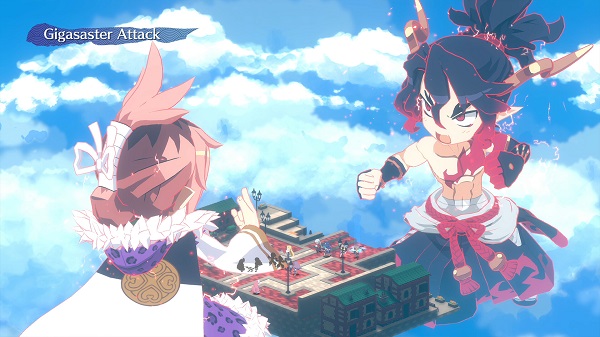
On the Switch 2, performance and controls generally hold up well, with responsive inputs that suit both handheld and docked playstyles. Navigating menus – an essential part of Disgaea’s loop – feels smoother than before, though the interface still suffers from occasional clutter given the density of options available. Visually, the shift to 3D character models continues to be a divisive choice; while animations are expressive and battles are lively, some environments and assets lack the sharpness and personality of earlier 2D entries. Audio remains a strong point, with an energetic soundtrack and enthusiastic voice performances that reinforce the game’s chaotic tone, even if repetition can creep in during extended sessions.
As a package, Disgaea 7 Complete lives up to its name by delivering the most exhaustive version of an already content-rich strategy RPG. The added DLC and new features elevate the endgame into something that hardcore fans can sink hundreds of hours into, but they also exacerbate pacing issues and the series’ tendency toward grind-heavy progression. For those who missed the original release, this is easily the best way to experience it, while returning players will find enough new material to justify another descent into its addictive systems. It may not reinvent the formula, but it refines and expands it in ways that make this complete edition feel appropriately comprehensive.
PULMO review (PS5)
PULMO, developed by Emil Ismaylov and Denis Petrov and published on consoles by Sometimes You, presents itself as a deliberately compact and introspective puzzle experience – one that leans more on thematic resonance than mechanical complexity. Framed as part of a broader conceptual trilogy, it places players in control of a lone figure navigating faceless crowds, using environmental manipulation to subtly influence behavior. The premise is intriguing and, at its best, succeeds in conveying ideas about individuality and social dynamics, though its abstract storytelling can feel a little too understated at times, leaving some of its meaning open to interpretation rather than clearly communicated.
Gameplay revolves around spatial puzzles that gradually introduce new mechanics, often tying their solutions to the game’s thematic core. There’s a satisfying sense of variety here despite the short runtime, with several puzzles offering clever twists that momentarily surprise and engage. However, the overall difficulty curve remains fairly gentle, with only occasional spikes – most notably in segments that demand quicker reactions, which feel slightly out of step with the otherwise slow, contemplative pacing. As a result, while the game succeeds as a thoughtful “one-sitting” experience, it may leave players wanting a bit more mechanical depth or extended challenge.

Visually, PULMO adopts a stark, minimalist style that blends simple 3D environments with hand-drawn aesthetics, reinforcing its abstract tone. This approach works well in establishing atmosphere, but it also proves divisive. High-contrast imagery, abrupt visual effects, and occasional motion irregularities can cause discomfort, causing mild eye strain. On the audio side, the game fares more consistently, with its soundtrack and ambient design complementing the experience effectively and helping to carry the emotional weight of its quieter moments.
At roughly half an hour to an hour in length, PULMO is undeniably brief, but it generally aligns its scope with its ambitions. Features like level select and additional unlock conditions provide a modest incentive to revisit certain segments, though replayability remains limited. Ultimately, this is a game that prioritizes mood and message over longevity, and while not every aspect lands equally well – particularly in its visual execution – it offers a concise, occasionally thought-provoking journey. For players drawn to experimental, art-driven puzzle games, it’s an experience that feels purposeful, even if it doesn’t fully realize all of its conceptual potential.
 Press Play Media