
We’re reviewing four recent ports today, spanning over three decades of gaming history. Here are 3D Don’t Die Mr. Robot, S. Prysm Destroyer, Hyper Mirror Run and the Accolade Sports Collection.
3D Don’t Die Mr. Robot review (PS5)
Infinite State Games’ “3D Don’t Die Mr Robot” reimagines a indie title, transitioning from 2D to 3D while retaining its addictive arcade essence. Players guide Mr. Robot through the Neon Dunjun, dodging diverse enemy patterns and collecting explosive fruits that obliterate foes upon contact. Strategically chaining these fruit explosions not only clears adversaries but also amplifies scores, introducing a compelling risk-reward dynamic.
The game offers multiple modes to cater to different playstyles. Remix Mode presents 50 handcrafted levels with varied objectives, each challenging players to achieve bronze to platinum rankings. Arcade Mode emphasizes endurance, tasking players with surviving relentless enemy waves to climb online leaderboards. Lime Attack Mode is a timed challenge focusing solely on lime collection, while Chill Out Mode provides a more relaxed experience.

Visually, the game bursts with color, complemented by a pulsating techno soundtrack that enhances the high-octane atmosphere. Controls are precise and responsive, crucial for navigating the increasingly chaotic environments. However, minor issues include Mr. Robot occasionally snagging on corners, which can disrupt the flow. Customization enthusiasts will appreciate the coin-based system, allowing for the purchase of various accessories for Mr. Robot, adding a personal touch to the gameplay.
In essence, “3D Don’t Die Mr Robot” successfully captures the spirit of classic arcade games, delivering a challenging yet rewarding “just one more go” experience. Its blend of simple mechanics with escalating difficulty ensures both newcomers and veterans will find something to enjoy in the neon-lit arcade adventures of Mr. Robot.
S. Prysm Destroyer review (PS5)
S. Prysm Destroyer brings fast-paced run-and-gun action to the PlayStation 5, channeling classic arcade shooters like Contra but with a mech-based anime twist. Players take control of Amor and her towering mech, Prysm Destroyer, to battle robotic creatures across looping stages in a high-score-driven experience. While the premise sounds exciting, the execution is a mixed bag. The game’s focus on leaderboard-driven replayability means there’s no traditional campaign structure, and its four short levels repeat with increasing difficulty rather than offering new environments or enemy encounters. This can make the experience feel repetitive, despite the addition of unlockable costumes and escalating challenge levels.
The gameplay itself is straightforward and enjoyable in short bursts, with solid run-and-gun mechanics and an array of over-the-top power-ups that temporarily boost firepower. The jetpack adds some mobility, but the inability to shoot downward while moving can feel restrictive when using it. The biggest challenge comes from the game’s permadeath system – players only get one life per run, meaning a single mistake can send you back to the start. This creates tension but can also be frustrating, especially when unexpected hazards instantly end a run. While the game does reward mastery, the lack of checkpoints or stage variety means the core gameplay loop wears thin over time.
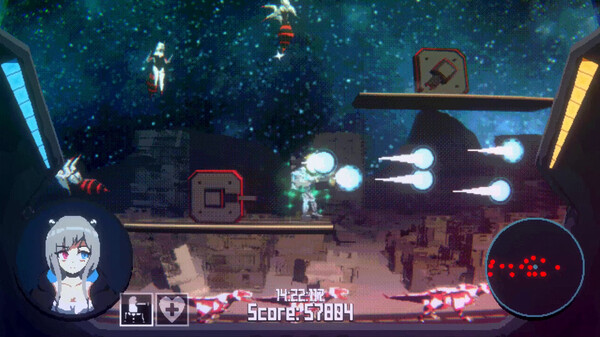
Visually, S. Prysm Destroyer leans into a PS1-inspired aesthetic with washed-out colors and a heavily stylized interface meant to mimic a mech’s cockpit. While the anime influences are clear, the visuals can feel rough, with occasional blurriness and clipping issues. The chaotic action can also make it difficult to track what’s happening on-screen, especially when flashy power-ups fill the screen. The soundtrack, however, is fittingly energetic, complementing the fast-paced gameplay with a mix of rock and electronic beats that match the game’s high-energy aesthetic.
Ultimately, S. Prysm Destroyer offers a fun but limited arcade-style experience. Its simple yet satisfying combat and score-chasing mechanics can be enjoyable for players looking for a challenge, but its lack of level variety and punishing permadeath system may turn others away. Fans of old-school shooters with an anime flair might find something to like, but for many, the game’s short runtime and repetitive design will limit its long-term appeal.
Hyper Mirror Run review (PS5)
Hyper Mirror Run delivers a fast-paced platforming challenge that keeps players engaged, whether they’re competing against an AI opponent or battling a friend in local versus mode. The game’s premise is straightforward – race to collect gems, grab a key, and reach the flag before your opponent, all while dodging traps and dispatching enemies. With five distinct worlds and 55 levels, there’s plenty of variety in stage layouts, hazards, and even boss encounters that mix things up at the end of each world. While the mirrored world concept adds a fun twist, the real highlight is the competitive nature of the gameplay, which shines most in multiplayer.
The platforming itself is easy to pick up, and the inclusion of different weapons gives players an extra toolset for dealing with obstacles. While the game isn’t particularly difficult – especially on its easiest setting – traps, enemies, and bosses provide enough of a challenge to keep things interesting. Boss fights are relatively simple but introduce new mechanics, requiring players to adjust their strategies slightly, whether it’s avoiding falling projectiles or timing jumps to land hits. Collecting gems adds an extra layer of strategy, offering additional lives that can make a difference in later stages. However, the AI opponent isn’t particularly tough to beat, making solo play less engaging compared to facing off against another player.

Visually, Hyper Mirror Run embraces a retro pixel-art aesthetic, with colorful environments that change between worlds. The character designs are charming, and there are various skins to unlock, adding a bit of personality to the experience. The soundtrack complements the gameplay well, with energetic tunes that match the fast-paced action. Controls are responsive, and while the game keeps things simple, the ability to switch weapons and time jumps precisely gives players enough control to navigate each level smoothly. The local multiplayer mode adds replay value, but the lack of an online component means those without a second player will have to settle for AI competition, which doesn’t offer the same thrill.
Ultimately, Hyper Mirror Run is a fun and accessible platformer, offering quick bursts of competitive action at an affordable price. While the single-player experience is enjoyable, it’s the versus mode that truly makes the game shine, giving players an incentive to return for head-to-head matchups. The lack of online play and the relatively easy AI may limit long-term appeal for solo players, but for those looking for a lighthearted, arcade-style platforming challenge with a competitive edge, this is a solid pick.
Accolade Sports Collection review (PS5)
The Accolade Sports Collection brings five classic sports titles to the PlayStation 5, aiming to evoke nostalgia among retro gaming enthusiasts. This compilation includes Hardball!, Hardball II, Hoops: Shut Up and Jam! (perhaps also known as Barkley: Shut Up and Jam!), Winter Challenge, and Summer Challenge, each offering a glimpse into the sports gaming landscape of the early ’90s.
Hardball! and Hardball II were notable baseball simulations in their time, but their transition to modern consoles reveals limitations. The original Hardball! suffers from simplistic gameplay and subpar controls, diminishing its appeal today. Its sequel, Hardball II, presents slight improvements but still falls short of contemporary standards, making it more of a nostalgic artifact than an engaging experience – if you’re used to the likes of MLB The Show, this will feel rough – while soccer games from the same era like Sensible Soccer still retain their charm.

Hoops: Shut Up and Jam! attempts to capture the essence of street basketball with its two-on-two format. However, the absence of an NBA license and the omission of Charles Barkley in this re-release detract from its authenticity. The game’s overly rapid pace and less responsive controls hinder the overall enjoyment, especially when compared to its contemporaries like NBA Jam.
The collection’s Olympic-style titles, Winter Challenge and Summer Challenge, strive to offer a variety of events but are hampered by technical shortcomings. Their attempts at faux-3D graphics result in poor frame rates and suboptimal controls, leading to a less satisfying gameplay experience. While the collection provides features like save states and visual filters, these enhancements do little to mitigate the inherent issues present in the original games – which were impressive for their time but haven’t aged as gracefully as the slightly older 2D games of the same kind.
In summary, the Accolade Sports Collection serves as a digital preservation of early ’90s sports titles but may struggle to captivate a modern audience. Its appeal largely rests with retro enthusiasts who appreciate gaming history, while others might find the dated mechanics and visuals less engaging.
 Press Play Media