Downloadable content has become a steady rhythm in the modern release cycle, extending a game’s lifespan while testing how far its core design can stretch without losing identity. This latest roundup looks at three very different approaches to post-launch support – from crossover-driven spectacle and pop-infused rhythm expansions to cinematic sports tie-ins – all built on established foundations. What unites them is a shared balancing act: adding enough new ideas to justify a return visit, while staying firmly within the boundaries that made the original experience work. The results are varied, but they offer a clear snapshot of how developers are choosing to expand, refine, and occasionally play it safe with their existing formulas.
Jotunnslayer: Hordes of Hel – Conan DLC review (PS5)
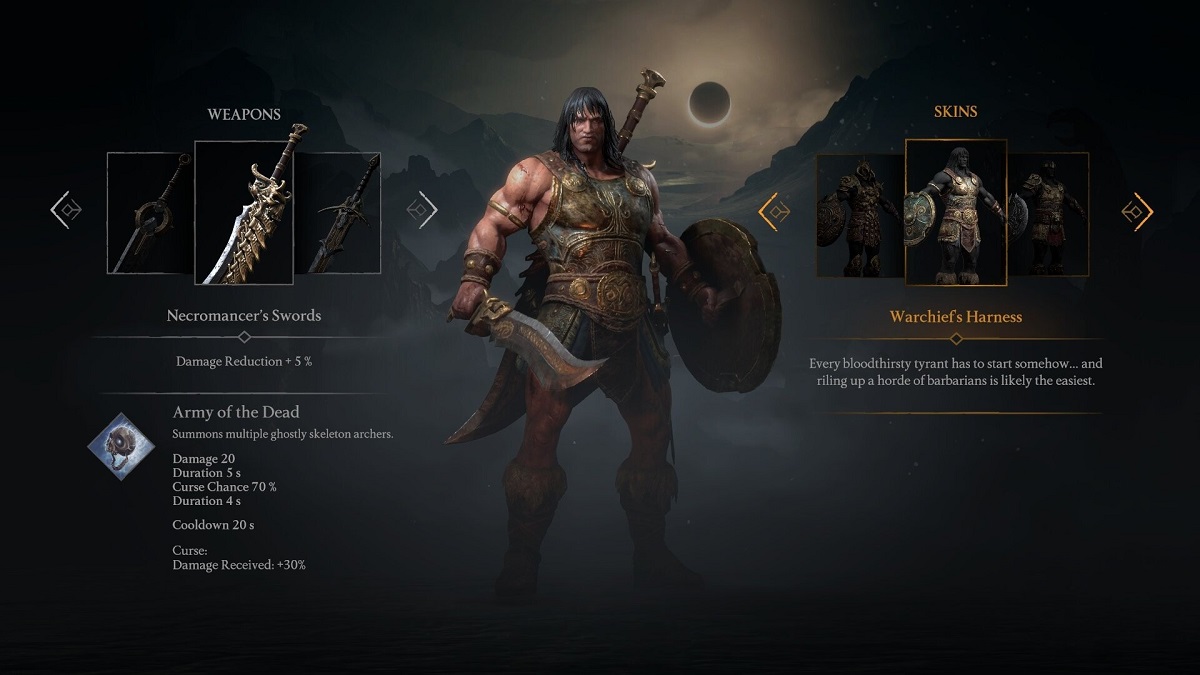
Stepping into the sandals of Conan in Jotunnslayer: Hordes of Hel feels like a natural extension of the game’s myth-soaked brutality, even if the crossover initially raises an eyebrow. The DLC drops the iconic barbarian into the Norse underworld with surprising ease, framing him less as a novelty and more as a fully integrated combatant whose presence aligns with the game’s relentless tone. While there’s unfortunately little in the way of narrative expansion beyond the setup of venturing into a new desert region and confronting another towering Jötunn, the thematic cohesion holds up well enough to keep the focus squarely on the action rather than the lore.
Gameplay is where the Conan addition makes its strongest case. His toolkit leans heavily into aggressive melee combat, offering a mix of sword-and-shield resilience, dual-wield speed, and heavier striking options that give players room to tailor their approach. The ability to block and charge through enemies adds a slightly more grounded, physical feel compared to some of the base game’s other characters, and he scales effectively into higher difficulty tiers. That said, not everyone will find his playstyle equally engaging, as some builds can feel straightforward rather than deeply versatile, especially for those who prefer more elaborate ability synergies.
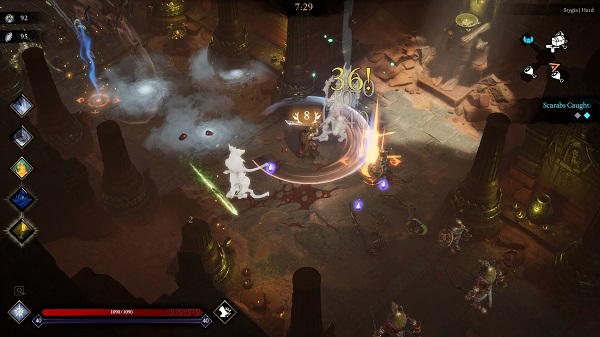
The new Stygian map provides a welcome shift in atmosphere, trading icy desolation for sand-swept ruins and underground corridors. Its layered design, with transitions between surface and subterranean spaces, adds variety and a sense of progression that the base environments occasionally lack. Encounters feel appropriately chaotic, culminating in a large-scale boss fight that leans into spectacle with waves of summoned enemies and heavy-hitting attacks. Even so, the overall scope remains relatively contained, and while the new content is polished, it doesn’t dramatically alter the core gameplay loop.
Visually, the desert setting introduces a warmer, more varied palette that contrasts nicely with the darker tones of Hel, while Conan himself is rendered with enough detail to feel authentic without clashing stylistically. Audio design follows suit, with impactful combat feedback and a soundtrack that maintains the game’s intensity, though it doesn’t significantly evolve the existing soundscape. As a package, this DLC lands as a solid but modest addition – worthwhile for those already invested in Jotunnslayer and curious about the crossover, but unlikely to convert skeptics on its own. It expands rather than redefines, delivering a focused slice of new content that fits comfortably within the game’s established framework.
Synth Riders – Dua Lipa DLC review (Quest)
Kluge Interactive continues to expand Synth Riders with a steady cadence of music packs, and the new Dua Lipa DLC leans fully into the game’s more dance-oriented side. Featuring seven tracks drawn from her catalog, the pack shifts the tone away from the title’s synthwave roots toward polished pop-disco, resulting in a noticeably different energy. Rather than framing itself around spectacle or a marquee “Experience” track, this release is more straightforward in concept, focusing on movement and accessibility over audiovisual experimentation – a decision that feels both intentional and slightly conservative given past highlights.
That focus pays off most clearly in the gameplay. The track selection lends itself well to flowing, full-body choreography, with several maps emphasizing smooth transitions and rhythmic consistency over sharp, reactive inputs. Songs like “Hallucinate” and “Houdini” stand out for their balance between readability and complexity, encouraging players to settle into a groove rather than chase high scores through abrupt motions. This makes the pack particularly effective for longer sessions or fitness-oriented play, as the routines maintain a steady intensity without becoming overly punishing.
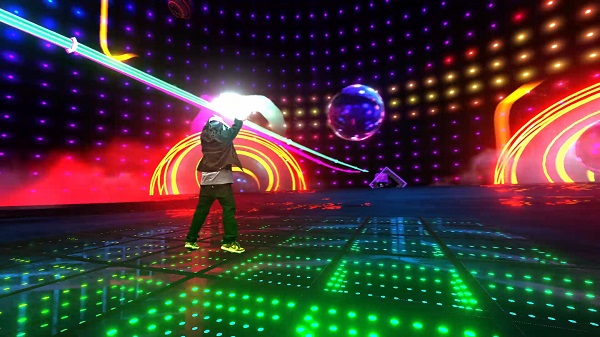
Controls on Meta Quest remain as responsive and reliable as ever, and the mapping here plays to those strengths. There’s a clear emphasis on intuitive hand placement and lateral movement, which lowers the barrier to entry while still offering depth on higher difficulties. At times, though, the consistency in flow can blur the distinction between tracks, with fewer standout mechanical hooks compared to some of the more experimental earlier packs. The absence of a dedicated “Experience” track is especially noticeable in this context, removing a layer of visual and mechanical variety that has historically elevated certain DLC releases.
Visually and sonically, the pack is cohesive but restrained. Dua Lipa’s production style translates well into the game’s neon aesthetic, reinforcing the sense of rhythm and momentum, yet it rarely pushes beyond the established template. For players who enjoy the more mainstream, dance-heavy side of Synth Riders, this is easily one of the most immediately enjoyable packs to date, offering strong replay value through its smooth choreography and energetic soundtrack. However, those looking for bold visual experimentation or genre diversity may find it a bit too safe, making it a polished and fun but less adventurous addition to the game’s growing library.
NBA Bounce – GOAT: The Movie DLC review (PS5)
The GOAT: The Movie DLC for NBA Bounce builds on the base game’s lighthearted, arcade-style basketball foundation by injecting a dose of cinematic flair and character-driven progression. Framed loosely around the themes of the GOAT film, the expansion introduces a set of new playable characters and a climb-based structure that adds a sense of upward momentum, though its narrative ambitions remain more thematic than fully developed. It leans into a celebratory, almost cartoonish take on basketball stardom rather than telling a deep story, which fits the tone but also limits its emotional engagement, especially if you haven’t enjoyed the film yet.
Gameplay sees the most meaningful additions, with new modes like The Cage offering a tighter, more competitive environment that contrasts with the base game’s more chaotic party vibe. The Climb structure provides a clearer sense of progression, encouraging repeated playthroughs as players work their way up through increasingly challenging encounters. That said, the core mechanics remain largely unchanged, meaning that anyone already fatigued by the base game’s relative simplicity may find that this DLC doesn’t dramatically alter the moment-to-moment feel. It’s still accessible and easy to pick up, but that accessibility comes at the cost of depth, especially for more experienced players.
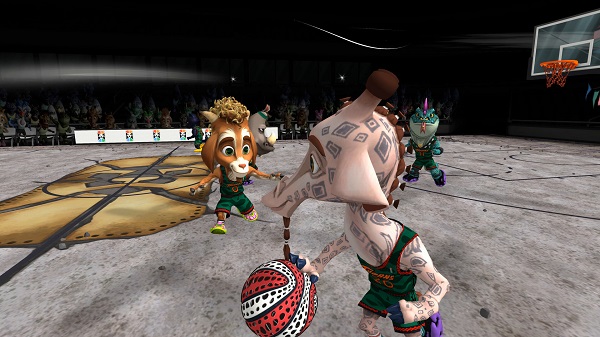
Controls remain responsive and approachable, reinforcing the game’s family-friendly design, but they can also feel a bit limited when the action intensifies. The addition of new characters does bring some variety in style and presentation, yet they don’t significantly diversify gameplay strategies. Visually, the DLC continues the game’s colorful, exaggerated aesthetic, with bold animations and lively courts that match its playful tone. Audio design complements this well, featuring upbeat tracks and energetic effects, though it rarely stands out as a defining element of the experience.
As an expansion, GOAT: The Movie succeeds in broadening NBA Bounce with new content that fits seamlessly into its existing framework, but it stops short of reinventing it. For players already invested in the game, the added modes, characters, and cosmetic rewards provide a welcome reason to return, especially in multiplayer settings where its chaotic charm shines brightest. However, those hoping for a more substantial evolution of the formula may find it more incremental than transformative, reinforcing the strengths – and limitations – of the base experience.
 Press Play Media