
Hack ’n’ Stack is a cooperative action and tower defence game from Triple Boris Inc., released under the Dodo Tako and Sticky Rice Games labels. Its premise combines resource gathering, construction and frantic combat, tasking players with protecting their base from increasingly troublesome waves of enemies. The concept has potential, particularly for those who enjoy games that turn teamwork into a source of both success and comedy. However, while the individual ingredients make sense on paper, bringing them together requires a careful balance between strategy and chaos. Hack ’n’ Stack can deliver entertaining moments when everyone works towards the same goal, but its demanding pace and occasionally awkward execution prevent it from being an entirely satisfying experience on the Nintendo Switch.
The objective is straightforward: collect resources, transport them to the appropriate locations and use them to build barricades, walls and defensive turrets. Players must protect their base while preventing enemies from reaching the machinery they are trying to destroy. The construction system offers some interesting decisions, as raw materials can be stacked to create makeshift obstacles, while properly constructed walls provide sturdier protection. Raising turrets can also improve their effectiveness by giving them a better vantage point. This gives the building mechanics a practical purpose beyond simply filling the battlefield with objects. Unfortunately, the game introduces much of this complexity early on, leaving newcomers with plenty to learn while the clock is already ticking. Rather than gradually introducing its systems, Hack ’n’ Stack can feel as though it expects players to understand several interdependent mechanics almost immediately.
Cooperation is consequently central to the experience, and the game is at its most appealing when everyone establishes a clear role. Some players can concentrate on collecting and transporting materials, others can construct defensive structures, while another teammate keeps watch over the base and deals with enemies that break through. As the waves become more demanding, these responsibilities need to remain flexible, with everyone ready to abandon their current task when the situation deteriorates. This creates opportunities for satisfying last-minute saves and the kind of frantic conversations that make cooperative party games memorable. A hastily assembled barricade holding back a horde just long enough to finish a turret can feel like a genuine team achievement. The problem is that the limited preparation time can undermine these strategic possibilities, particularly when a small team must cover several tasks at once. Some players may find themselves spending more time fighting enemies directly than constructing the defences that are supposed to make the game distinctive.

The physics-based interactions add another layer of unpredictability. Players can pick up objects, throw enemies around and even grab their teammates, turning otherwise ordinary encounters into potential comedy. When these mechanics produce an unexpected chain reaction, they can generate exactly the sort of shared fun that makes a cooperative game worthwhile. Yet there is a fine line between amusing disorder and unnecessary frustration. Accidentally picking up a teammate when trying to grab a resource might be funny once, but the same interruption becomes less welcome when the next enemy wave is approaching. The game seems particularly dependent on players being willing to laugh at mistakes rather than becoming annoyed by them. That approach works well for groups who enjoy chaotic multiplayer sessions, but those looking for a more precise and strategically focused tower defence experience may find the physics distracting.
The controls contribute to this mixed impression. Movement, combat, resource handling and construction all need to coexist in an experience where time is rarely on the player’s side. A dedicated construction mode helps with positioning objects, and the ability to stack materials offers a degree of control over how defences are arranged. Nevertheless, placing structures accurately under pressure can be awkward, especially when a carefully planned wall needs to be completed before the next wave arrives. The physical interactions also make it possible for simple tasks to become unexpectedly cumbersome. There is entertainment to be found in the resulting mishaps, but the distinction between intentionally chaotic gameplay and controls that occasionally get in the way is important. When a defence fails because the team has made a poor tactical decision, the setback can be instructive; when it fails because building feels unnecessarily fiddly, the experience is considerably less rewarding.
Progression offers a reasonable amount of content for a relatively modest cooperative game. The campaign features four distinct worlds and 24 levels, with additional objectives encouraging players to place barricades and turrets in designated locations to earn better results. These challenges give experienced teams reasons to revisit stages and refine their approach instead of merely rushing towards the exit. The difficulty also increases as players advance, requiring better communication and more deliberate division of responsibilities. Once a group has settled into a rhythm, the escalating demands can provide a satisfying sense of improvement. However, the underlying structure remains largely unchanged from one mission to the next. Collect resources, construct defences, repel three waves and move on: this loop is easy to understand, but its repetition becomes more noticeable over time. The additional objectives offer some welcome variation, yet their rewards feel limited when the stars earned through successful play do not meaningfully expand character customisation or unlock substantial new incentives.
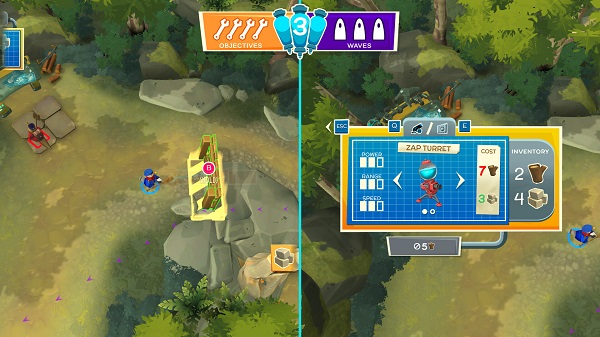
Playing alone is possible, but it appears to be a considerably less convincing way to experience the game. The central design assumes that several players will divide the workload, allowing one person to gather resources while another handles construction and someone else defends the base. A solo player must manage these responsibilities simultaneously, often travelling between resource points and defensive positions while enemies threaten multiple areas. The difficulty does not scale sufficiently to compensate for the reduced workforce, making certain encounters feel unnecessarily punishing. This limits the game’s flexibility, particularly for players who cannot reliably assemble a group. Local and online multiplayer provide more suitable ways to play, and are almost a requirement in a game so dependent on cooperation.
Visually, Hack ’n’ Stack adopts a colorful, cartoon-inspired style that suits its light-hearted premise. The animal characters and gelatinous enemies help establish an approachable tone, while the ability to customise characters with accessories gives players a little room for personal expression. The straightforward presentation also fits the game’s emphasis on quick decisions rather than elaborate storytelling. There is no particularly deep narrative driving the action: the kingdom needs defending, the base must survive, and the next wave is never far away. That simplicity is not inherently a problem for a party game, but it does mean that much of the personality must come from the characters, the visual comedy and the situations created by the physics.
Ultimately, Hack ’n’ Stack is an appealing idea that does not consistently find the right balance between its different systems. Its strongest moments come from cooperative problem-solving, improvised construction and the occasional physics-driven disaster that leaves everyone laughing. The four worlds, 24 levels and optional objectives provide a reasonable foundation for several multiplayer sessions, while the increasing difficulty gives coordinated teams something to work towards. However, repetitive objectives, a demanding learning curve, occasionally imprecise construction and limited incentives for further progression hold it back. The solo experience also seems poorly suited to a design built around distributing tasks among several people. Players who enjoy chaotic local multiplayer and are happy to learn through trial and error may find enough entertainment here, especially with a group of friends who can communicate and adapt. Those expecting a polished, strategically deep tower defence game, or a party game that anyone can immediately understand, may be less impressed. Hack ’n’ Stack has the right ingredients for an enjoyable cooperative diversion, but its execution does not always allow them to work together as effectively as they should.
Score: 6.5/10