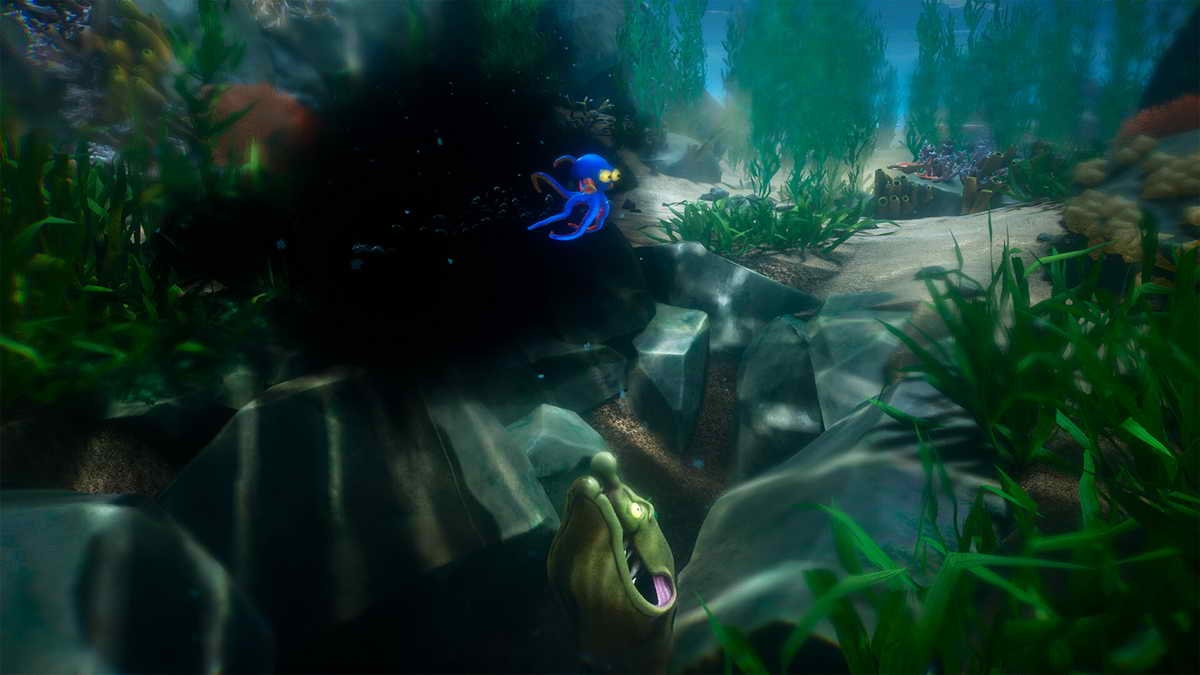
Darwin’s Paradox, developed by ZDT Studio and published by Konami, is a cinematic puzzle-platformer with a disarmingly unusual protagonist: a small octopus caught in a sprawling industrial conspiracy. The premise is immediately striking, blending slapstick humor with a gradually unfolding sci-fi narrative that hints at something far larger than Darwin himself. While the story leans heavily on environmental storytelling rather than overt exposition, that approach works both for and against it – creating intrigue through implication, but sometimes lacking the narrative momentum needed to fully capitalize on its more ambitious ideas.
That duality extends into the tone as well. Darwin’s journey is framed with a light, almost cartoon-like sensibility, where expressive animation and visual gags carry much of the emotional weight. At its best, this gives the game a distinct personality, allowing players to project meaning onto Darwin’s reactions and the absurd situations he stumbles into. However, the broader narrative arc can feel underdeveloped, with limited escalation or payoff, leaving the experience more episodic than cohesive.
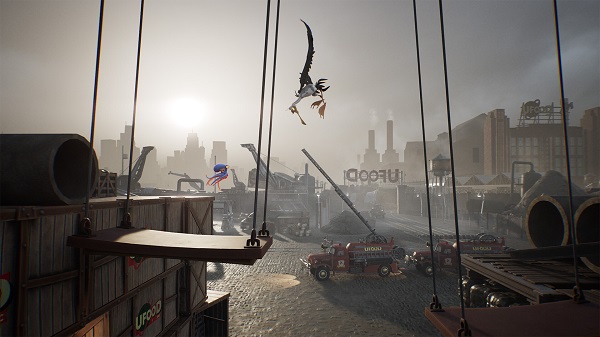
Mechanically, the game’s strongest asset is its commitment to building everything around the physiology of an octopus. Movement is tactile and versatile, with suction-based climbing, camouflage, and ink-based interactions forming the backbone of both traversal and puzzle-solving. These abilities shift dynamically depending on whether you’re in water or on land, creating a layered design that encourages experimentation. When the game leans into this interplay – particularly in its more thoughtful puzzle sequences – it delivers a steady rhythm of clever problem-solving that feels both intuitive and fresh.
That said, the design isn’t always as focused as its core concept suggests. Stealth elements become increasingly prominent as the game progresses, sometimes introducing frustration due to unclear enemy behavior or inconsistent feedback. Similarly, certain action-heavy segments and one-off mechanics can disrupt the pacing, feeling underdeveloped compared to the more refined puzzle-platforming foundation. The result is a game that oscillates between inspired and uneven, with its best ideas undermined at times by less cohesive design decisions.
Controls largely support the experience, particularly in fluid underwater sections where Darwin’s movement feels at its most natural and responsive. On land, however, traversal becomes more deliberate and sometimes less precise, which can exacerbate difficulty during timing-sensitive sequences. This contrast is clearly intentional, reinforcing the “fish out of water” concept, but it doesn’t always translate into satisfying gameplay, especially when combined with trial-and-error hazards or less forgiving platforming challenges.

Visually, Darwin’s Paradox is consistently impressive, embracing a 2.5D presentation that layers detailed environments with expressive animation. There’s a clear cinematic ambition here, with character movement and environmental detail evoking the feel of an animated feature. However, that same richness can occasionally work against clarity, as busy backgrounds or foreground elements make it harder to distinguish interactive objects from decorative ones. Having said that, this is one of those games that’s a joy to just watch others play as well. The audio design is serviceable and fitting, but rarely memorable enough to elevate key moments.
Ultimately, Darwin’s Paradox is a game defined by its creativity as much as its inconsistency. Its central idea – building an entire platforming experience around the unique capabilities of an octopus – is executed with genuine ingenuity, resulting in moments that feel both original and engaging. Some slight lack of cohesion in its broader design, from uneven pacing to underdeveloped mechanics, prevents it from fully realizing its potential, but what remains is a charming, inventive adventure that’s easy to recommend with caveats – one that showcases flashes of brilliance, even if it never quite evolves into something truly exceptional.
Score: 8.0/10
 Press Play Media